
Beautiful and Stunning Cantonese Export Art

Proudly from Canton: Muwen Tang Collection of Cantonese Export Art
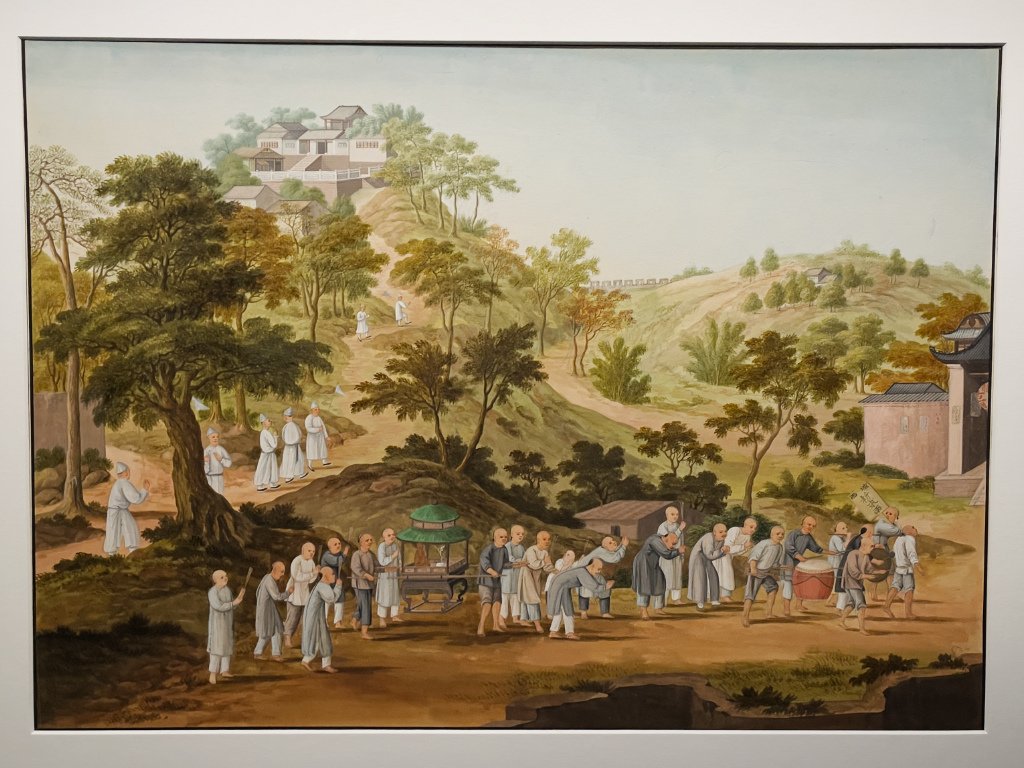
Praying for Rain, 19th century, Anonymous, Gouache on paper
The Muwen Tang Collection of Cantonese Export Art
On 29 May 2026, Dr Simon Kwan donated over 2,000 works with many fine examples of Cantonese export art to the Hong Kong Museum of Art . It was the largest single donation in its history. Proudly from Canton: The Muwen Tang Collection of Cantonese and Export Art presents over 120 sets of his donated works, offering a broad survey of Cantonese craftsmanship across media, markets and centuries.
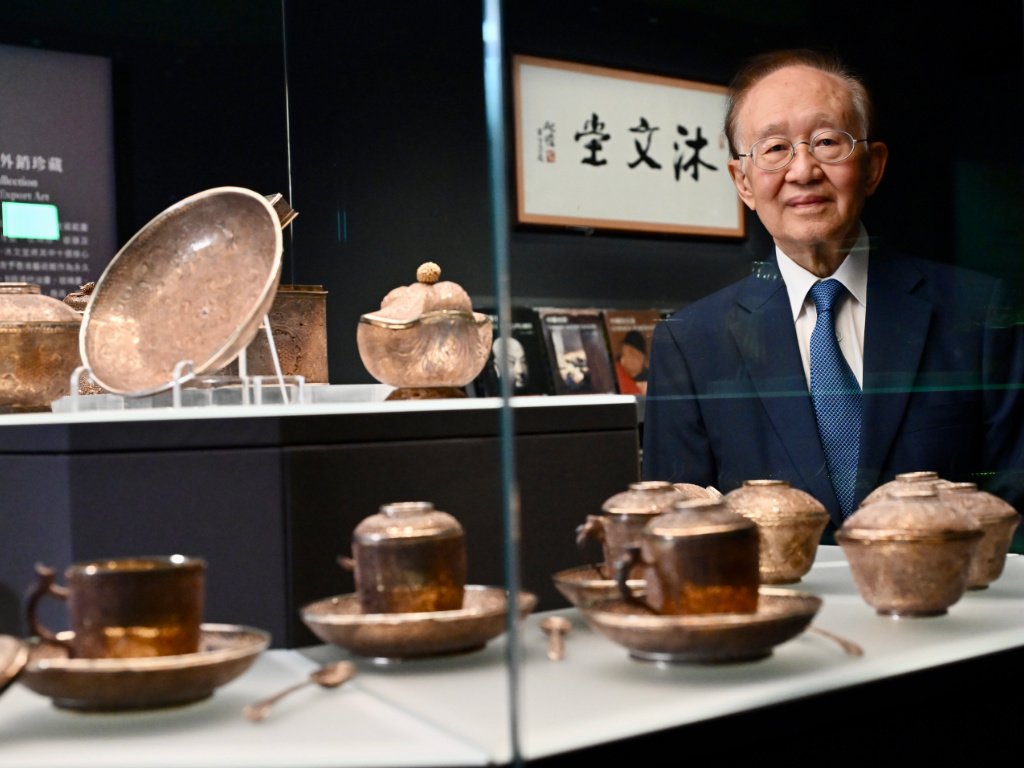
Dr Simon Kwan, Photo courtesy of Hong Kong Museum of Art
Cantonese Export Art: A major chapter in Chinese visual culture
Dr Kwan’s mark is visible across Hong Kong. As an architect, he has helped shape the city through major projects including the Hong Kong Academy for Performing Arts, the Hong Kong University of Science and Technology, Hong Kong Science Park, North Lantau Hospital, Kai Tak Children’s Hospital, Tin Shui Wai Hospital and the ICAC Headquarters.
Related Architectural legacy: Fabulously designed buildings by I M Pei
Yet Dr Kwan’s most enduring legacy may be cultural rather than architectural. He holds a doctorate in fine arts and has spent more than 50 years studying and writing about Chinese art, publishing more than 20 specialised volumes. That lifelong commitment has taken shape in the Muwen Tang Collection, now entering public view at the Hong Kong Museum of Art, where Kwan also serves as a Museum Expert Adviser.
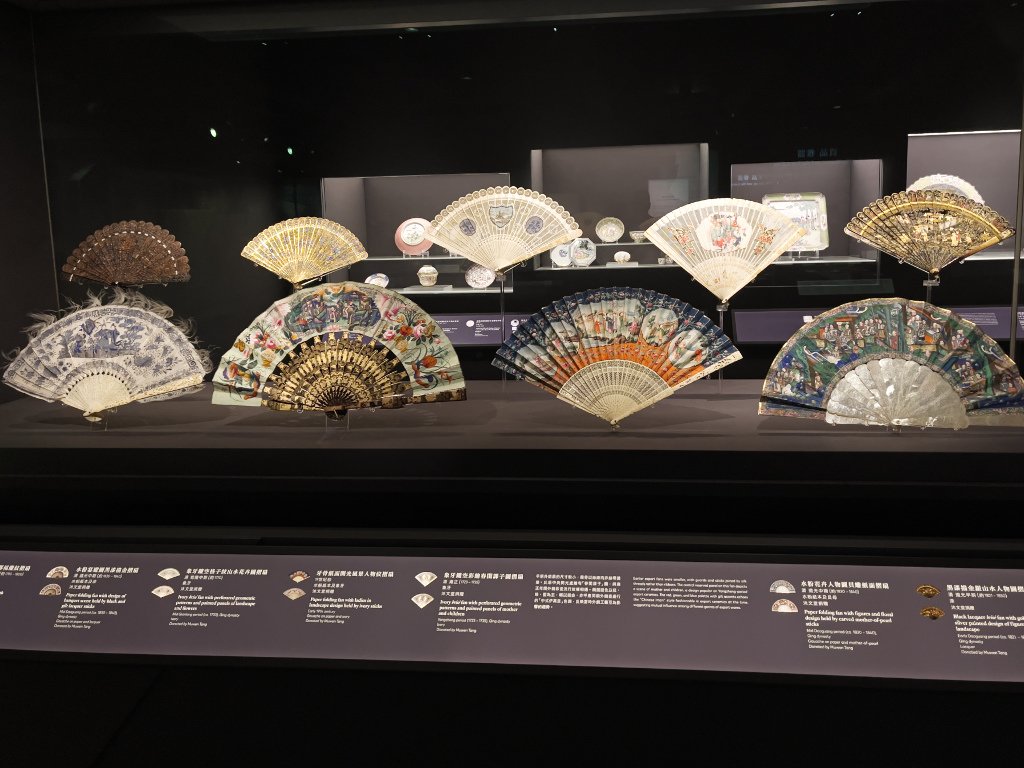
Gallery shot of Canton fans, Proudly from Canton, Cantonese and Export Art, HKMoA
What distinguishes Muwen Tang is not simply the rarity of its objects, but the intelligence of its collecting. Rather than pursuing prestige or conventional beauty alone, Kwan built the collection around under-examined themes in Chinese material culture, with particular attention to the artistic and social worlds of Guangzhou.
Related Sam Tung Uk, A 200-year-old Hakka walled village built during the Qing dynasty
The result is a collection that spans Qing dynasty oil paintings, reverse-glass paintings, gouache and pith paintings, painted enamels, export silverware, fans, textiles, ivory carvings, lacquerware, and timepieces. Together, these works show how Cantonese artisans responded to imperial taste, local demand and overseas markets with remarkable fluency, setting up the exhibition’s first section.
Qing dynasty export paintings
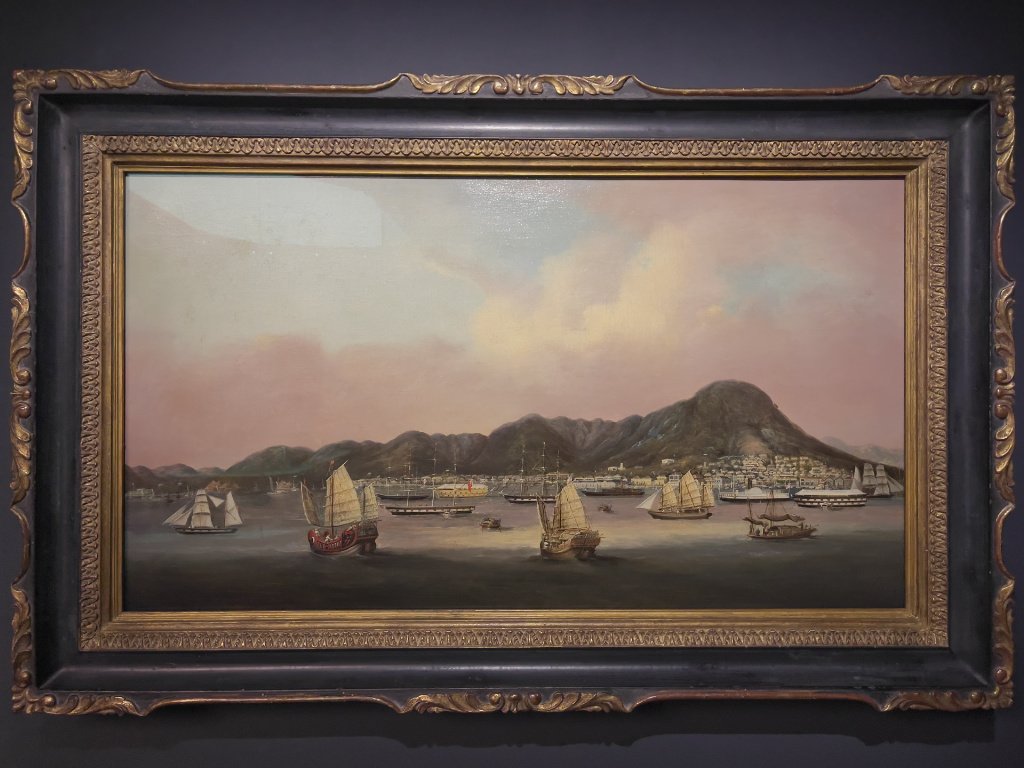
View of Victoria Harbour, Hong Kong, 1860s-1870s, Anonymous, Oil on canvas
As European prints, drawings and oil paintings reached southern China, Cantonese artists absorbed Western ideas of composition, perspective and modelling, then translated them into a local visual language. Export painters such as Spoilum and Lamqua catered to overseas buyers, while the academic style of George Chinnery, who lived in Macau, became a major influence on 19th-century Cantonese oil painting.
Related Twentieth-Century Chinese Oil Paintings Across Time and Space
The above View of Victoria Harbour captures Hong Kong in the 1860s and 1870s, when the city was emerging as a trading port of rising importance. Paddle steamers, junks and a hospital hulk animate the water, while St John’s Cathedral and Government House mark the skyline. Together, these details make the painting as much a record of urban change as a harbour scene.
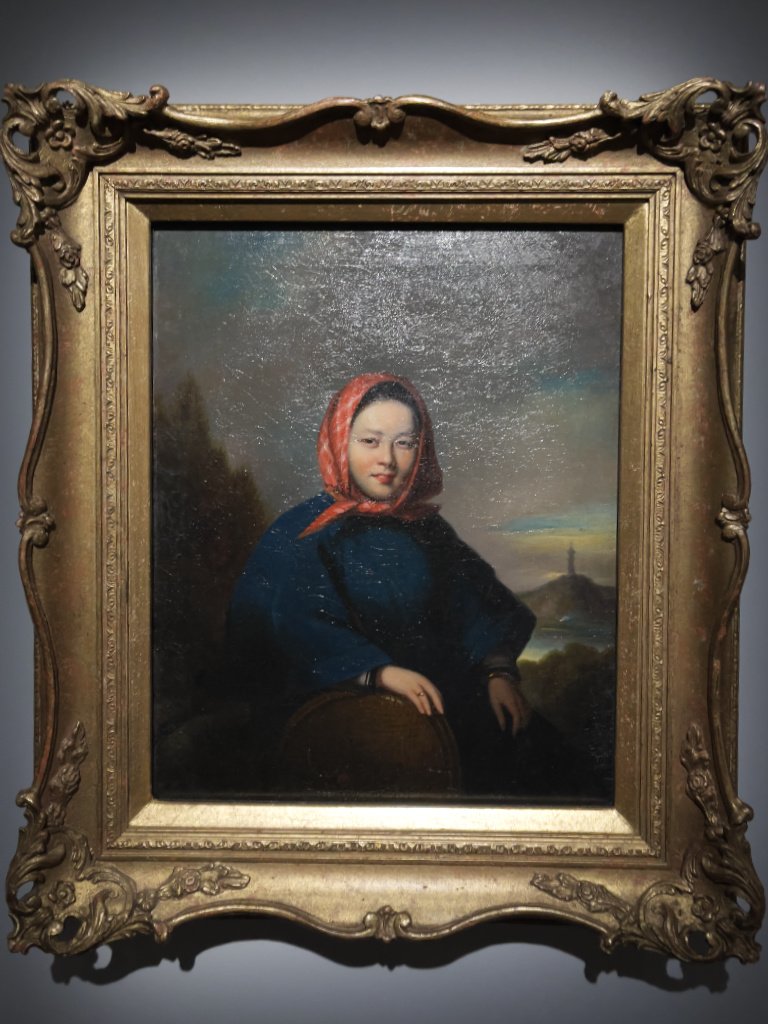
Portrait of a Chinese Sampan Girl Ah You, 1859, Lamqua, Oil on canvas
Lamqua’s Portrait of a Chinese Sampan Girl Ah You points to the same exchange, but on a more intimate scale. Active in Guangzhou during the 19th century, Lamqua adapted Chinnery’s academic style to produce portraits that matched foreign market tastes while retaining a striking sense of individuality in Ah You’s likeness.
Related Lingnan revolutionised Chinese calligraphy in the 20th century
Sampan girls were among the few Chinese women who had contact with Westerners in the southern coastal region, and they became recurring figures in export painting. Here, Ah You is both subject and symbol: a portrait shaped by observation as well as by the expectations of a transnational clientele.
Reverse glass paintings
Reverse glass painting is one of the exhibition’s most revealing hybrid forms. Cantonese artists painted on the backs of glass panels with oil or gouache, often adapting Western prints, and combined these imported techniques with Chinese landscapes, figures and folklore.
Related Chinese Reverse Glass Painting from the Mei Lin Collection
The medium itself captures the exhibition’s larger story: Cantonese art was not isolated from the world but was made through contact, adaptation, and exchange. These works travelled easily, looked striking from a distance and offered foreign buyers something both familiar and different.
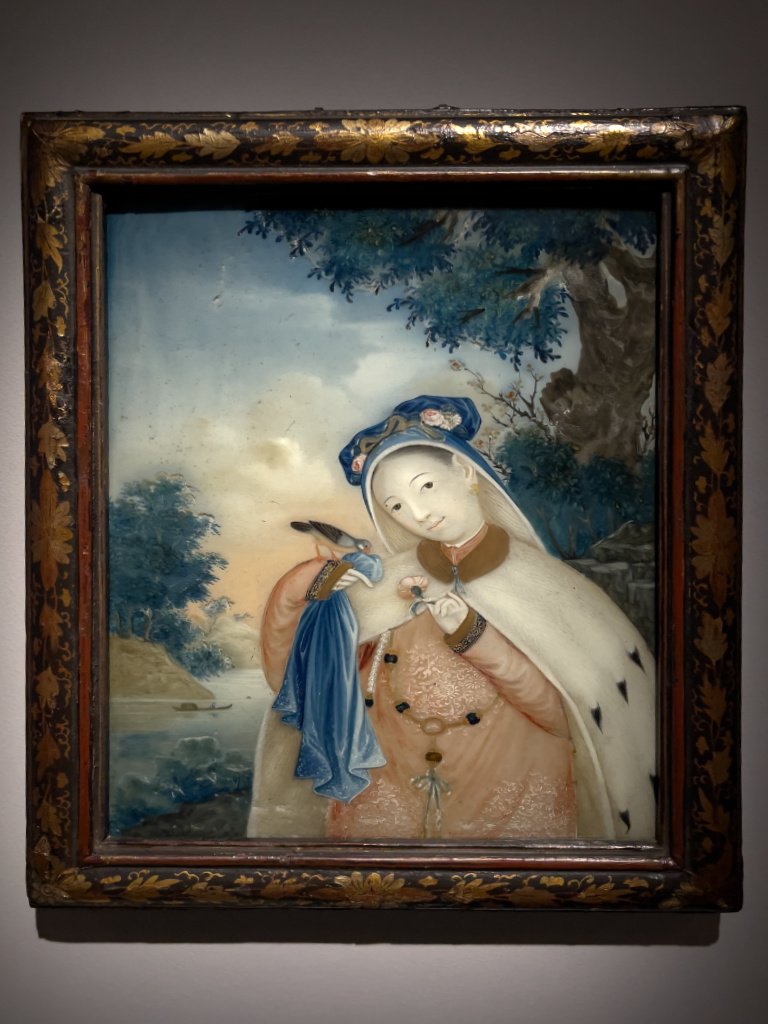
Enjoying a bird’s company in a cold forest, Mid 18th – mid 19th century, Anonymous, Reverse glass painting
In Enjoying a bird’s company in a cold forest, the female figure and boating scene carry a distinctly Eastern sensibility. Yet, the handling of light and shadow relies on Western pictorial methods. Together, these elements create a surface that feels both decorative and atmospheric, with a depth unusual in traditional Chinese painting.
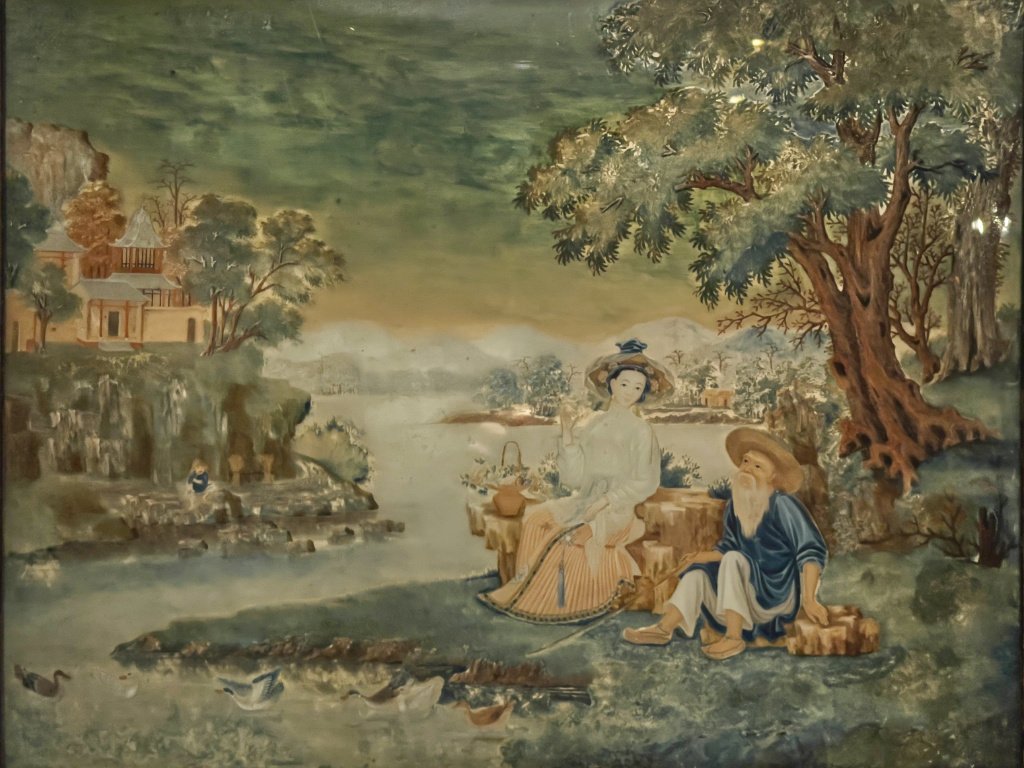
Resting in the Countryside, Mid 18th – mid 19th century, Anonymous, Reverse glass painting
Resting in the Countryside continues that dialogue between visual traditions. Also painted in reverse on glass, it uses tonal gradation and crisp detail to create a sense of volume, while remaining rooted in the storytelling and imagery of Cantonese export art.
Related Daring and irresistibly new Chinese Calligraphy
Together, the two works show how Guangzhou painters did more than imitate foreign models. They recast them into an export idiom that was commercially useful, visually distinctive and culturally hybrid, leading naturally into pith paintings.
If reverse glass paintings prized sheen and illusion, pith paintings prized delicacy and portability. Sold in sets and favoured by foreign buyers in the 1830s to 1860s, they were inexpensive to collect yet capable of extraordinary refinement.
Gouache and pith paintings
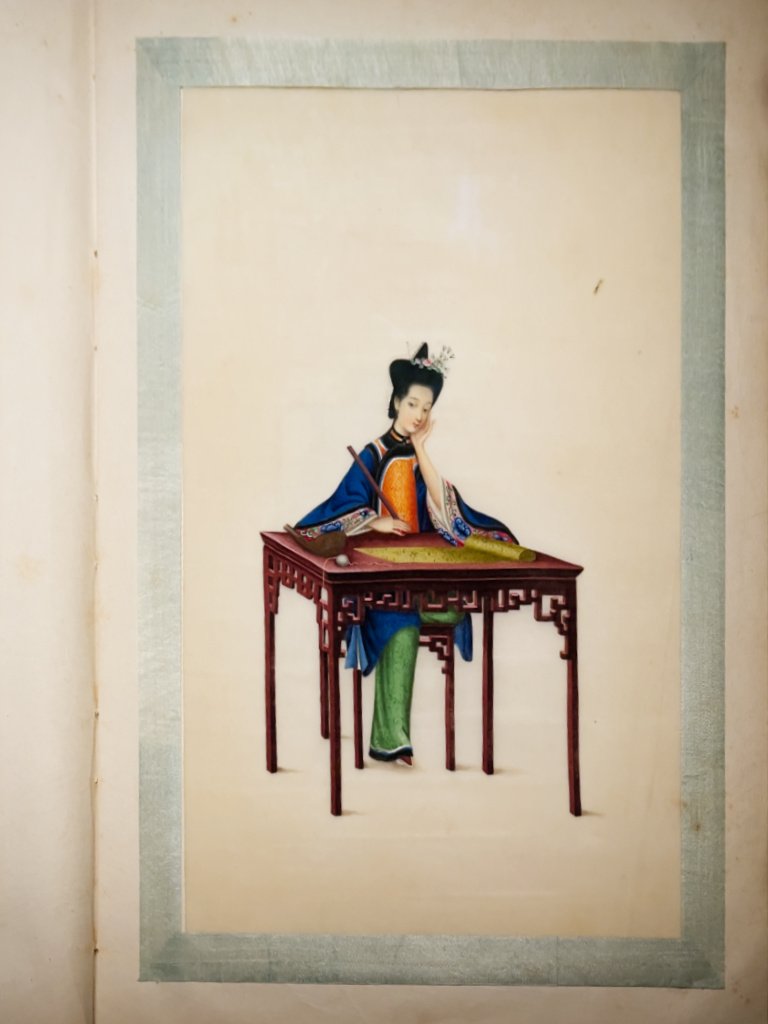
Album of Chinese Sewing Ladies, ca.1834, Sunqua, Gouache on pith paper, album of 12 leaves
Pith paper, made from the stem pith of the Tetrapanax papyrifera plant, has a soft, absorbent surface that allows pigment to sit lightly on top and create a faintly raised texture. In Sunqua’s Album of Chinese Sewing Ladies, that quality lends the figures a luminous presence, linking the material directly to the scenes of domestic labour and carefully composed export images.
Painted enamels
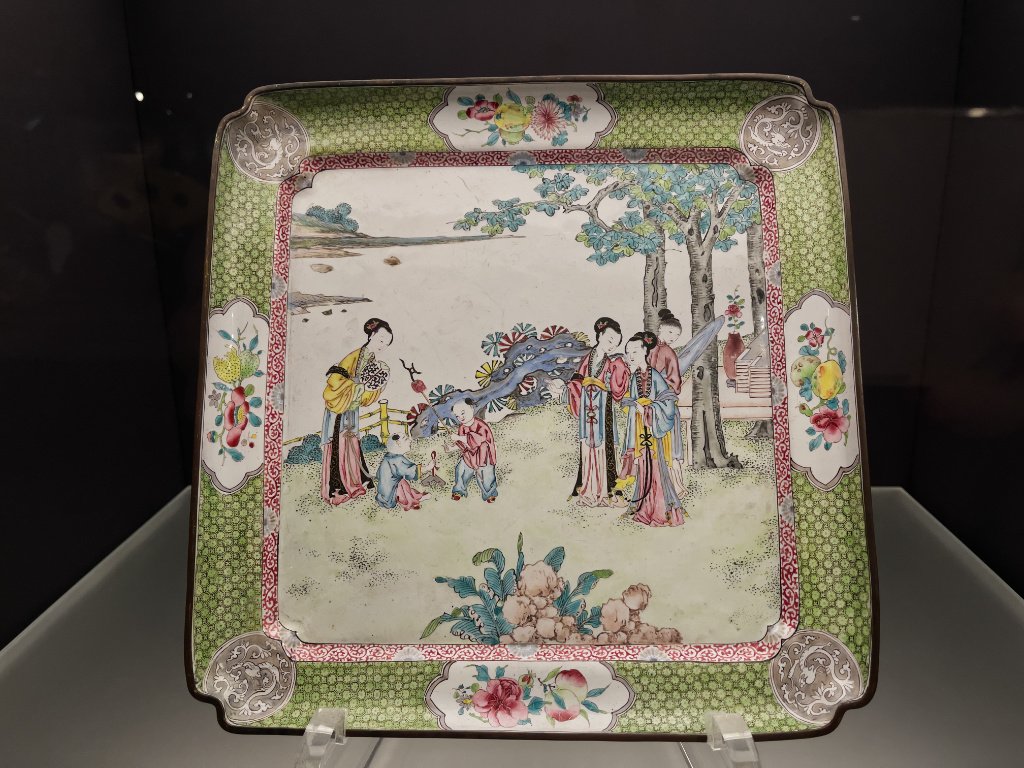
Indented-corner plate with design of children at play in painted enamels, Yongzheng period (1732-1735), Qing dynasty, Metal (copper)
Painted enamels show Cantonese artisans working on a smaller scale but with no less sophistication. Their bright colours and precise outlines transformed copper objects into refined decorative wares, often enriched with auspicious imagery and courtly elegance.
Related Ancient Chinese Gold symbol of power and wealth
This indented-corner plate with children at play is a good example of that balance. The playful scene and exacting craftsmanship work together, turning an everyday object into a compact display of technical skill and symbolic meaning.
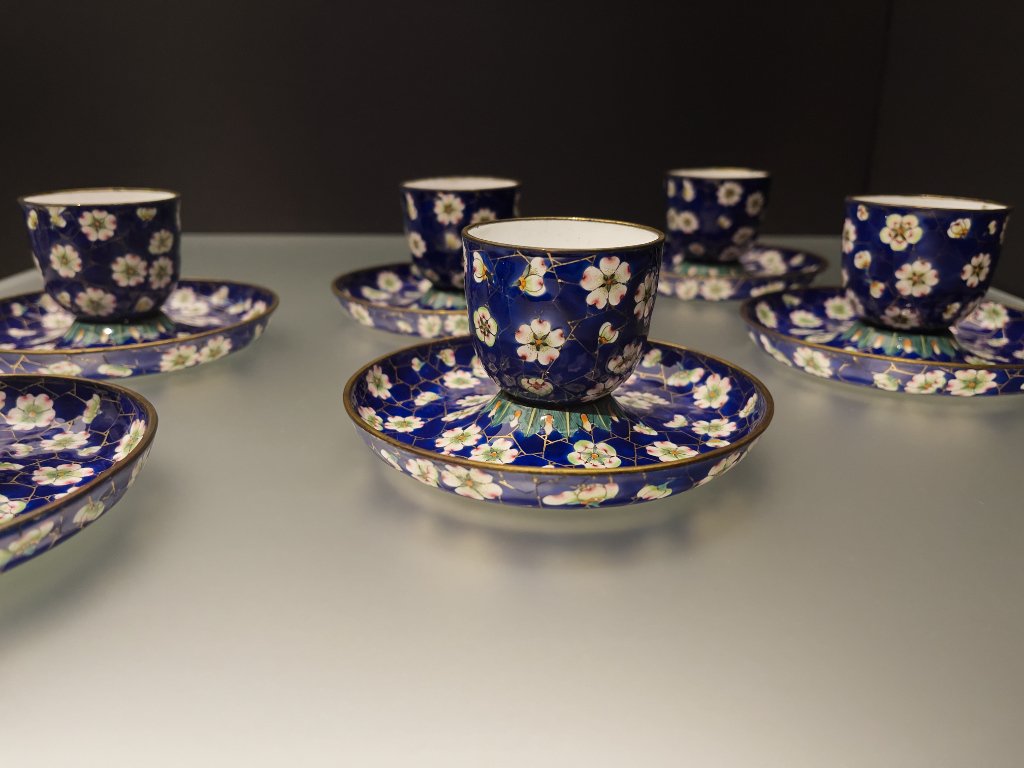
Set of cups and saucers with design of ice-crackled plum blossoms in painted enamels, Qianlong period (1736-1795), Qing dynasty, Metal (copper)
The set of cups and saucers decorated with ice-crackled plum blossoms offers a quieter kind of beauty. Plum blossoms suggest resilience and renewal, and here they appear in a restrained pattern that reflects the Cantonese gift for combining ornament with symbolic clarity in the object itself.
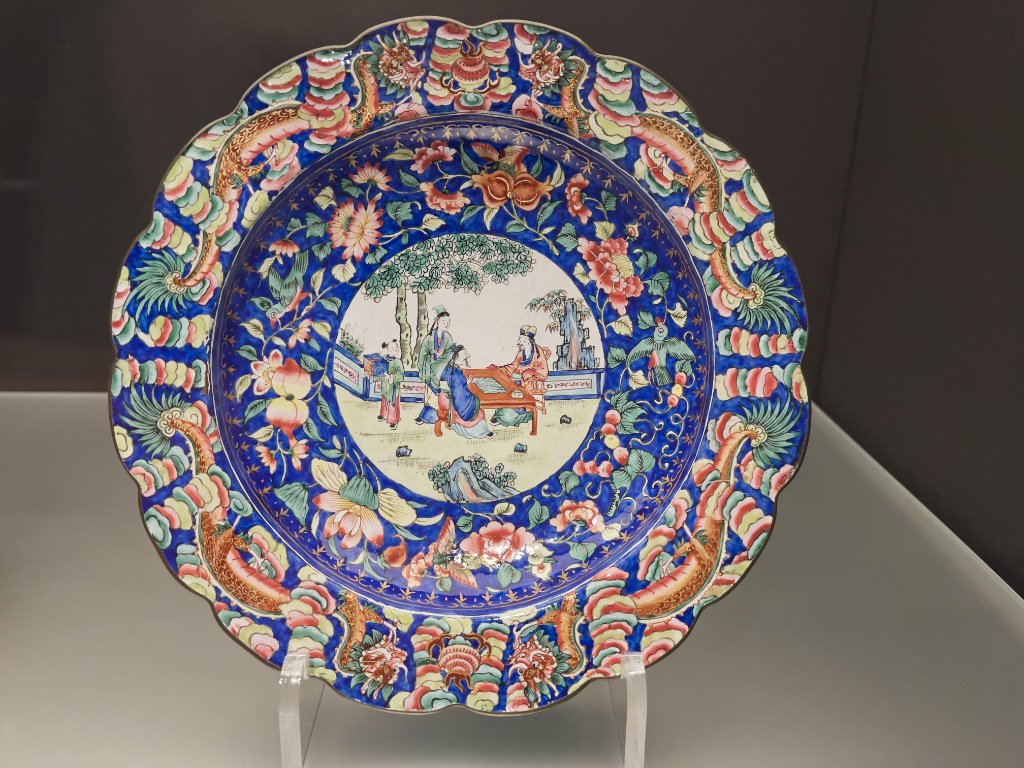
Vietnamese-style lobed dish in painted enamels, Jiaqing period (1796-1820), Qing dynasty, Metal (copper)
By the 19th century, export markets were shifting. As demand from Europe and America weakened, Southeast Asia became increasingly important for Canton enamels, and this Vietnamese-style lobed dish shows how makers adjusted to that change, before the exhibition turns to export silverware.
Related Legends and history of Hoan Kiem Lake, Vietnam
Its chess-playing figures, floral border and red dragons reflect Vietnamese taste, especially the three-quarter profile dragon associated with the Nguyen court. The dish points to a wider regional network, showing how Cantonese craftsmanship helped shape elite visual culture well beyond China.
Export silverware in a new age
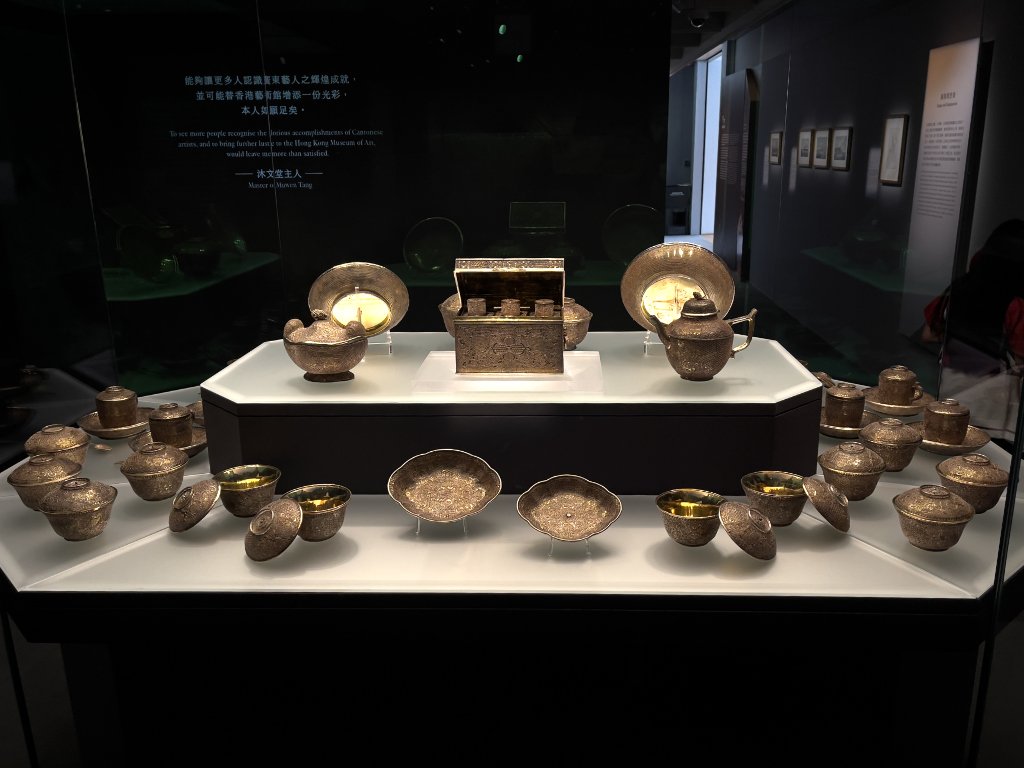
Gilt silver filigree tea service, Early Qianlong period (ca.1740-1750), Qing dynasty, Metal (gilt silver)
The exhibition’s highlight is the gilt silver filigree tea service, once part of the Dutch royal collection and owned by Queen Juliana. Produced in Guangzhou, it includes a tea caddy, teapot, sugar bowl, biscuit basket, trays and a full set of cups, all executed in intricate filigree with floral ornament.
Related Beautiful Tea Pots and Ware by Hong Kong Potters
As one of only two complete surviving Qing dynasty export filigree tea services known today, it is exceptional not just for its beauty but for its rarity. The set captures Cantonese silversmiths at the height of their technical ambition, showing luxury for a global market without losing the precision of local workmanship.
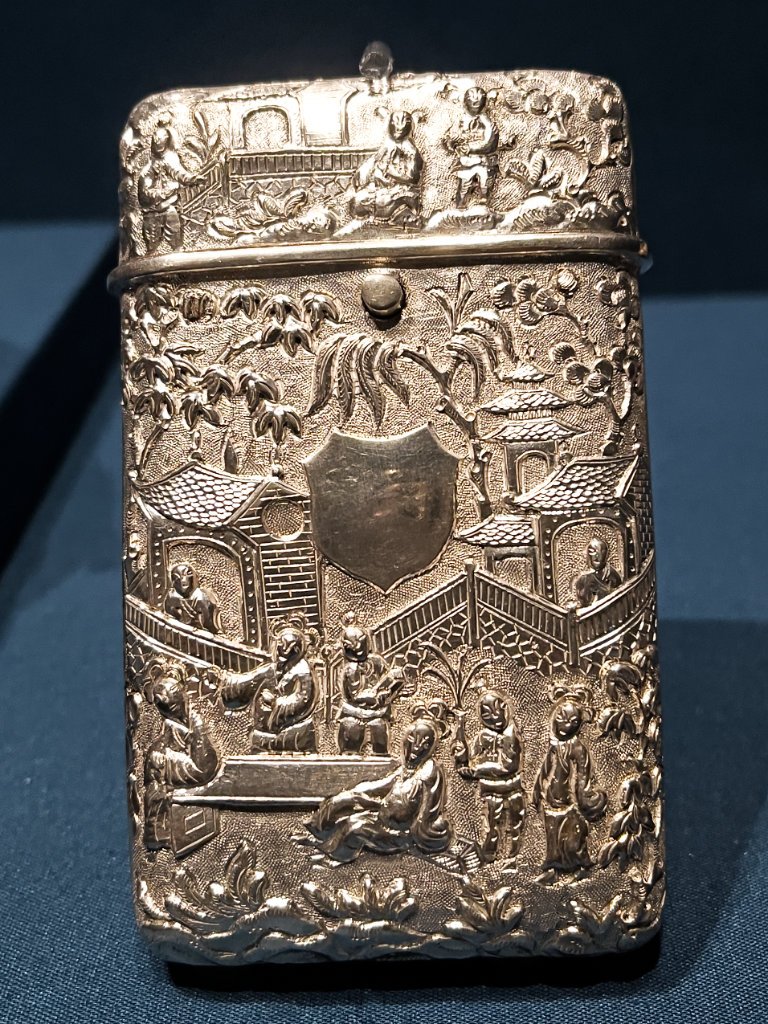
Silver card case with repoussé figures in landscape design, Hong Kong, Wang Hing, First half of the 20th century, Metal (silver)
By the 20th century, export silverware had become more compact and personal. This card case by Wang Hing shows how repoussé work and landscape imagery continued into a new era of consumption, where silver objects served as elegant accessories as much as display pieces.
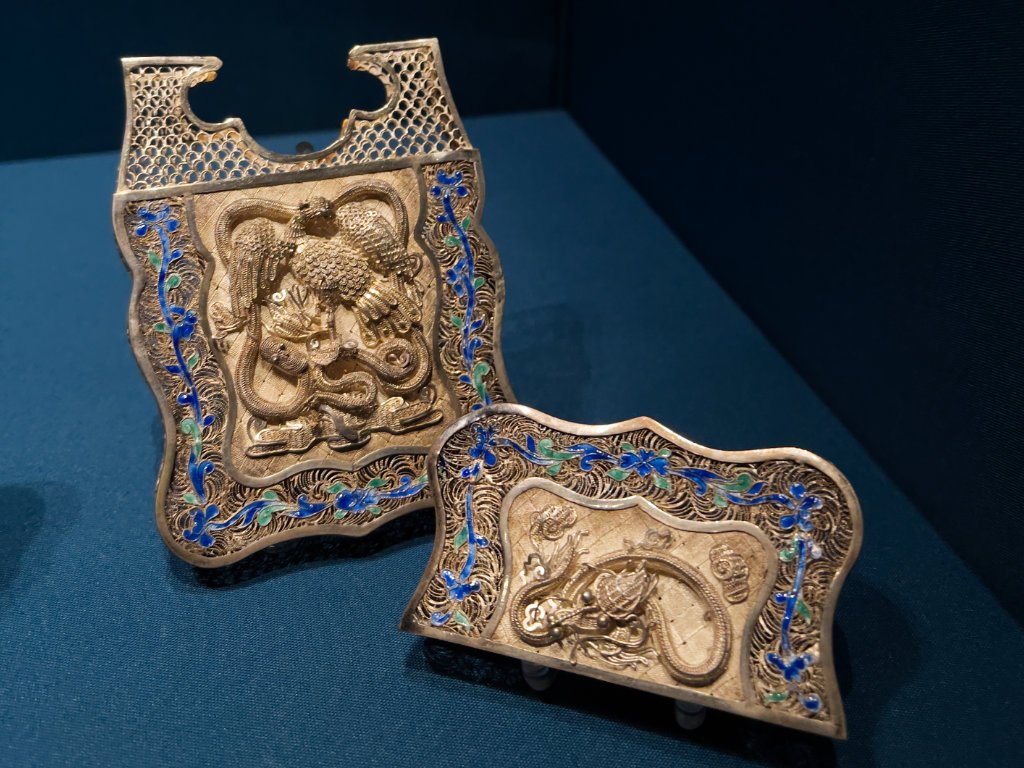
Gilt silver filigree card case, Late Qing dynasty (ca.1834-1911), Metal (gilt silver)
The gilt silver filigree card case carries the same refinement into an even smaller form. Delicate and portable, it turns the practical into the precious, showing how Cantonese makers extended the language of export silver into objects for everyday use.
Fans were a Cantonese luxury good circulated between worlds
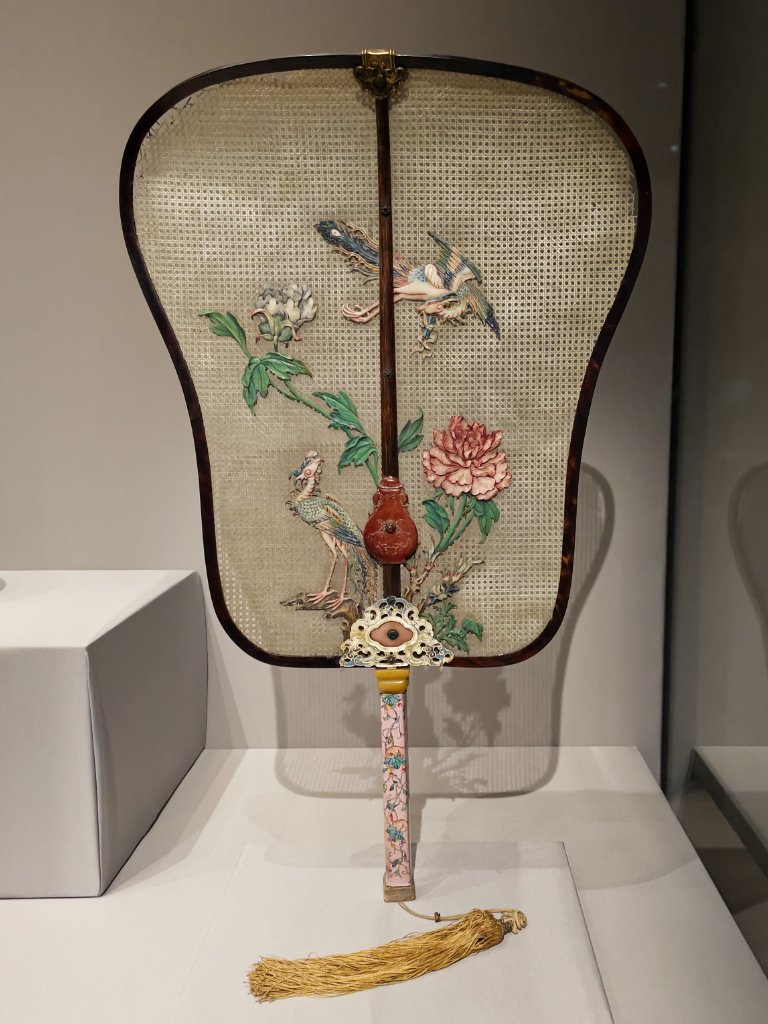
Woven ivory fan with design of phoenix and peony, Qianlong period (1736-1795), Qing dynasty, Ivory, tortoiseshell, mother-of-pearl and metal (copper)
Fans were among the most elegant Cantonese tribute and export objects, prized for their lightness, intricacy and display value. This woven ivory fan once belonged to the Qing court, and its leaf is made from ivory threads woven into a hexagonal pattern with astonishing precision.
Related Chinese Fragrance: A Feast of Sensational Scents
The fan’s surface is further enriched with carved and stained peony and phoenix motifs, while tortoiseshell, mother-of-pearl and kingfisher feathers deepen the sense of luxury. Together, these elements make it both a courtly object and a feat of handwork.
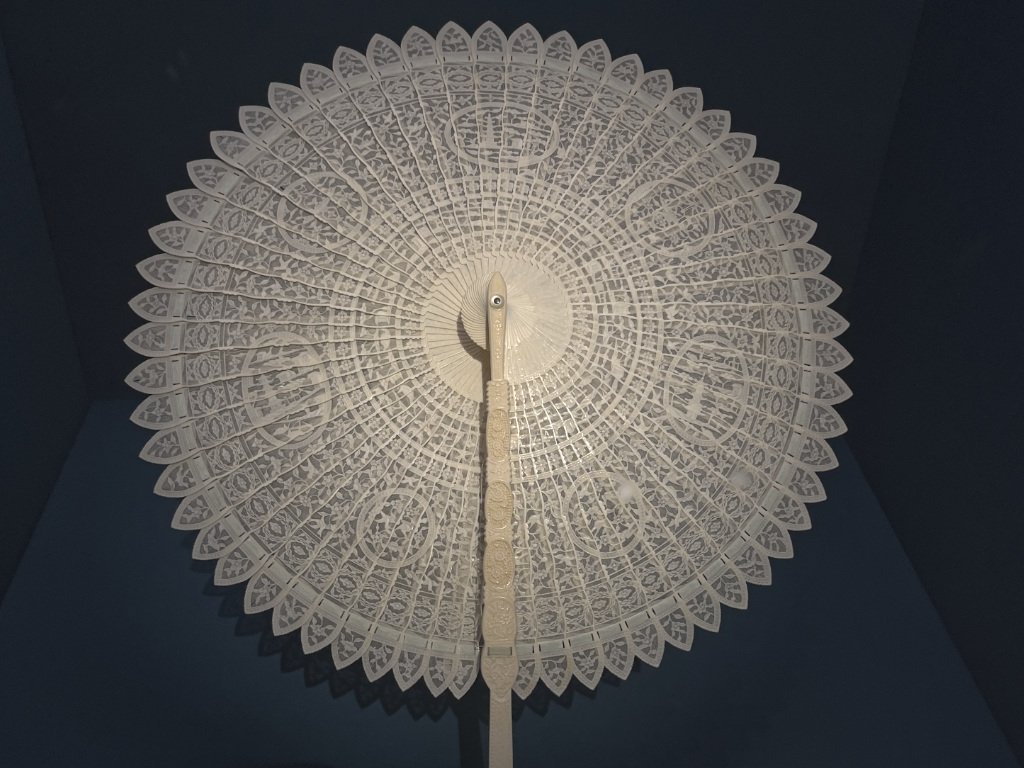
Ivory cockade fan with landscape and bird-and-flower design, Late Qianlong period (ca.1790), Qing dynasty, Ivory
The round ivory cockade fan unfolds into a full circle, with 60 carved sticks and reserved panels filled with landscapes and bird-and-flower scenes. Known abroad as a cockade fan, this type was especially prized among export ivory fans and was expensive to make.
Related Lavishly luxurious life of Qing Emperors and Empresses of Yuan Ming Yuan
Its rarity and short production period only added to its appeal. Even within the Qing court, such fans were often acquired by European royalty, underscoring the way Cantonese luxury goods circulated between worlds.
Ivory fans prized and expensive
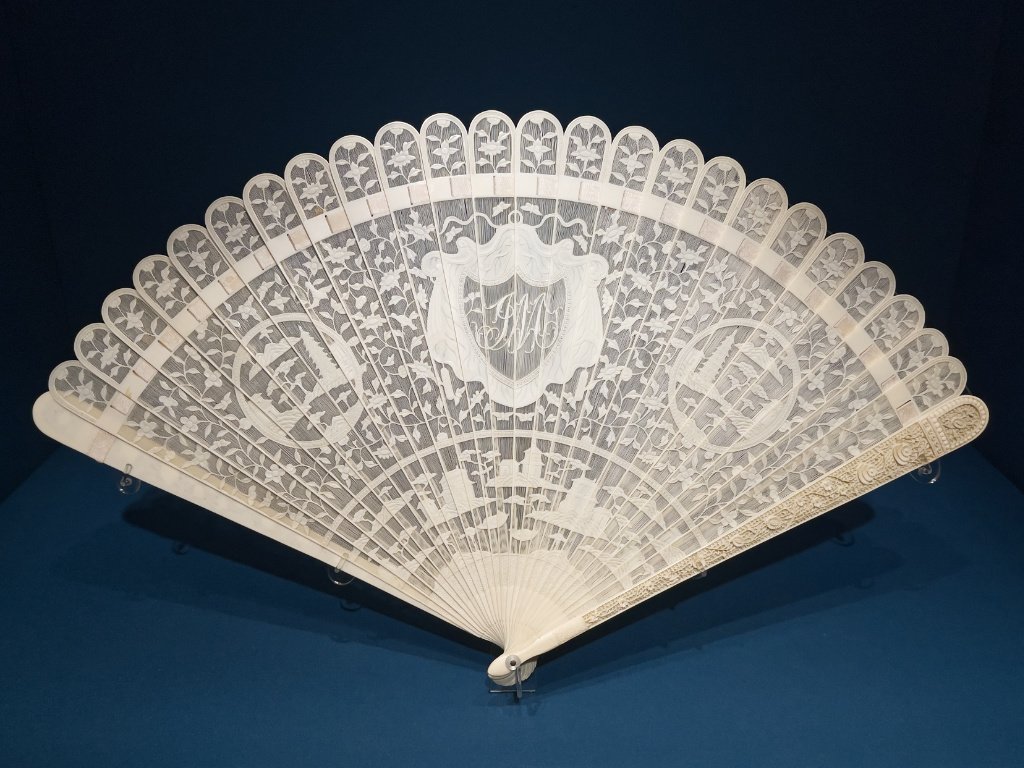
Ivory brise fan with monogram and floral design carved in openwork, Late Qianlong period (ca.1780), Qing dynasty, Ivory
Textiles and remarkable Cantonese embroidery
Cantonese embroidery reached a remarkable level of sophistication in the Qing dynasty, when it was valued both as tribute and as export ware. Known for its varied stitches, rich compositions and vivid naturalism, it could turn silk and thread into an almost pictorial medium.
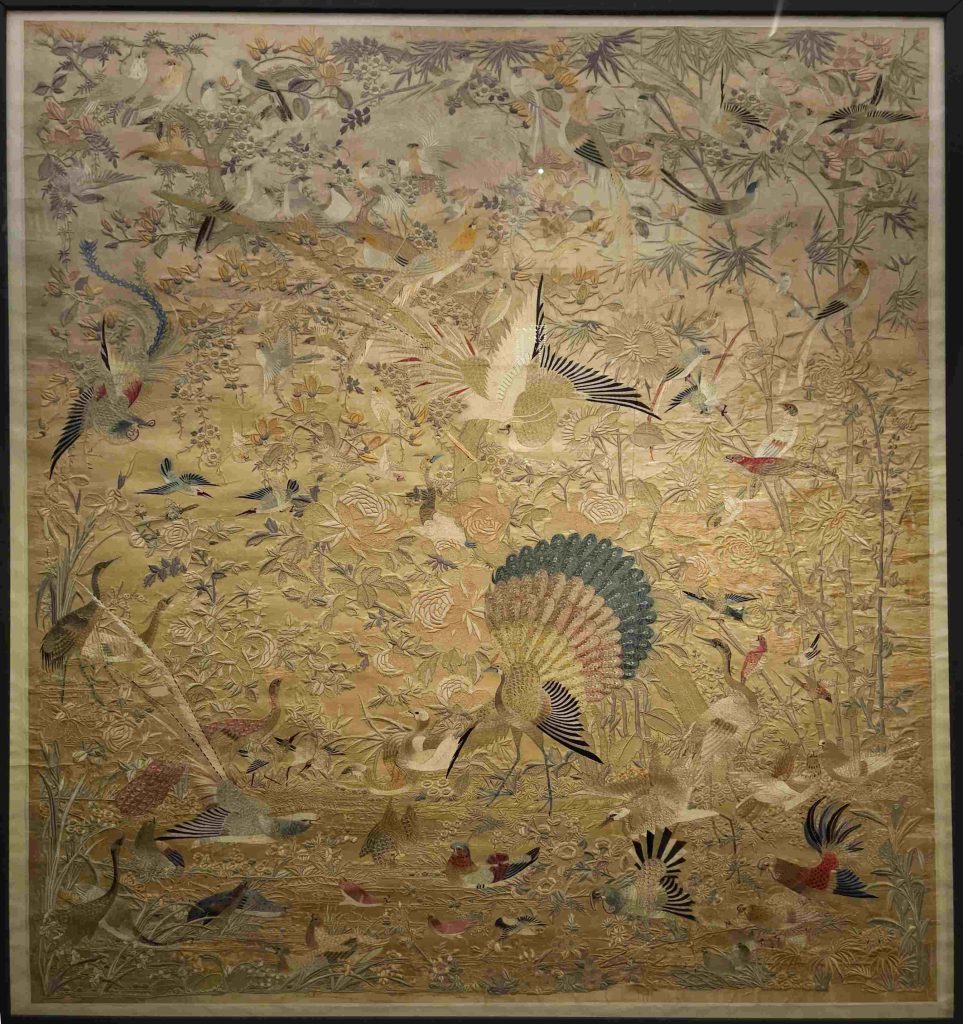
Embroidered panel with flower-and-bird design on beige ground, Qing dynasty (1644-1911), Textile
This monumental panel, with its hundred birds in song theme, is filled with birds, peonies, chrysanthemums and auspicious motifs. Its scale and density reveal why Cantonese embroidery was so admired: it combines visual abundance with remarkable technical control.
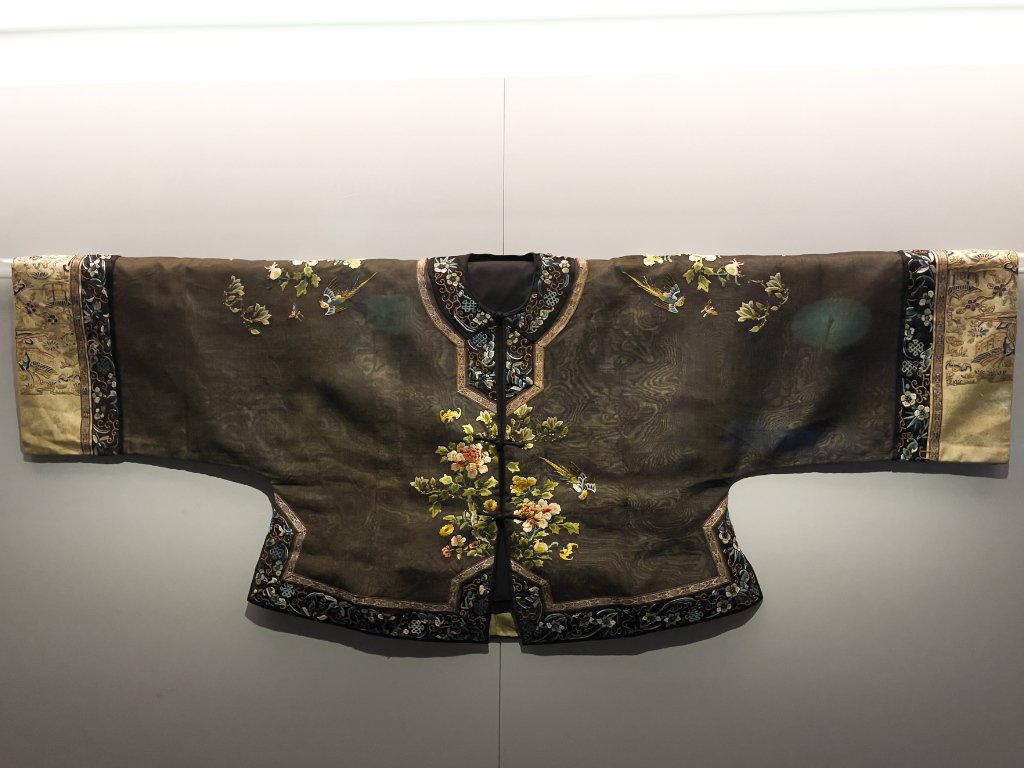
Upper garment embroidered with phoenix amidst peonies design on dark brown gauze, Qing dynasty (1644-1911), Textile
This garment brings the same sensibility into the sphere of dress. The dark brown gauze ground is embroidered with flowers, birds, bats and butterflies, while the collar, hem and cuffs are finished with coloured woven piping and layered decorative techniques.
Related Chinese Silk from the Qing dynasty: Stunning embroidery
The result is a textile of lightness and richness at once. Its surface shows how Qing women’s dress could combine utility, status and ornament in a single object.
Ivory carvings were another speciality of Cantonese Export Art
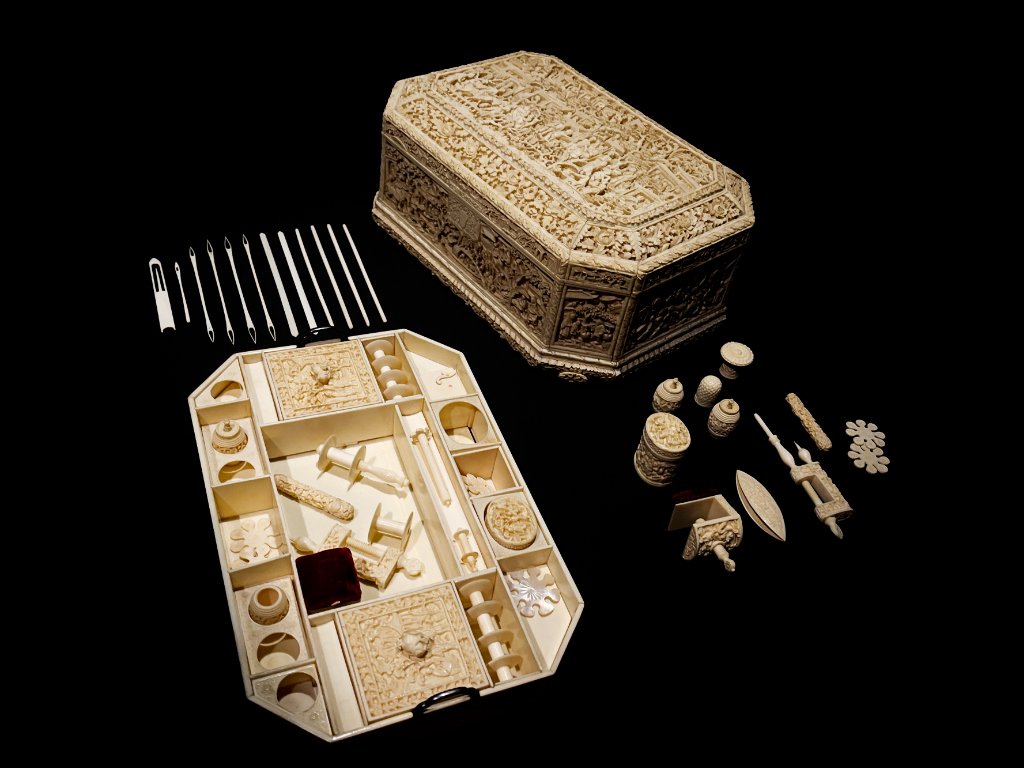
Octagonal box carved with figures in relief, Jiaqing to Daoguang period (1796-1850), Qing dynasty, Ivory
Ivory carving was another Cantonese speciality, especially in the production of luxury boxes and display pieces. This octagonal sewing box is covered in garden scenes and figures carved in dense relief, embodying the leave no ground exposed approach associated with Cantonese carving.
Related Tang dynasty golden age artistic highlights
Inside, an ivory tray holds sewing tools such as thread winders and thimbles, adding practical function to the object’s decorative density. It is a fine example of how Cantonese craftsmanship could make utility feel lavish.
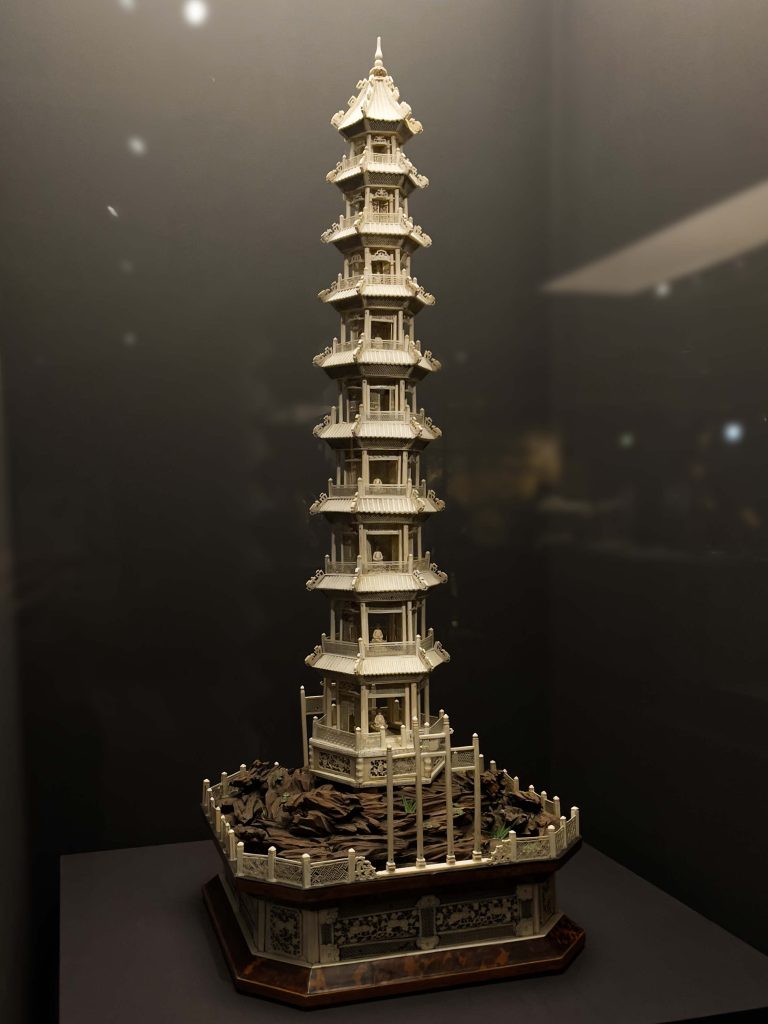
Nine-storeyed pagoda carved in openwork, Jiaqing to Daoguang period (1796-1850), Qing dynasty, Ivory
This pagoda brings together sculpture in the round, relief carving, openwork and assembly. Like many ivory pagodas of the Qing dynasty, it served both as tribute and as export ware, moving between sacred reference and commercial spectacle.
Related 8 Qing dynasty art pieces featured with 8 modern artworks
For Western viewers, the pagoda was one of the most recognisable emblems of China. For Chinese audiences, it remained linked to Buddhist devotion and relic worship, making it a form that could speak across cultures without losing its symbolic weight.
Lacquerware revered in European royal and private collections
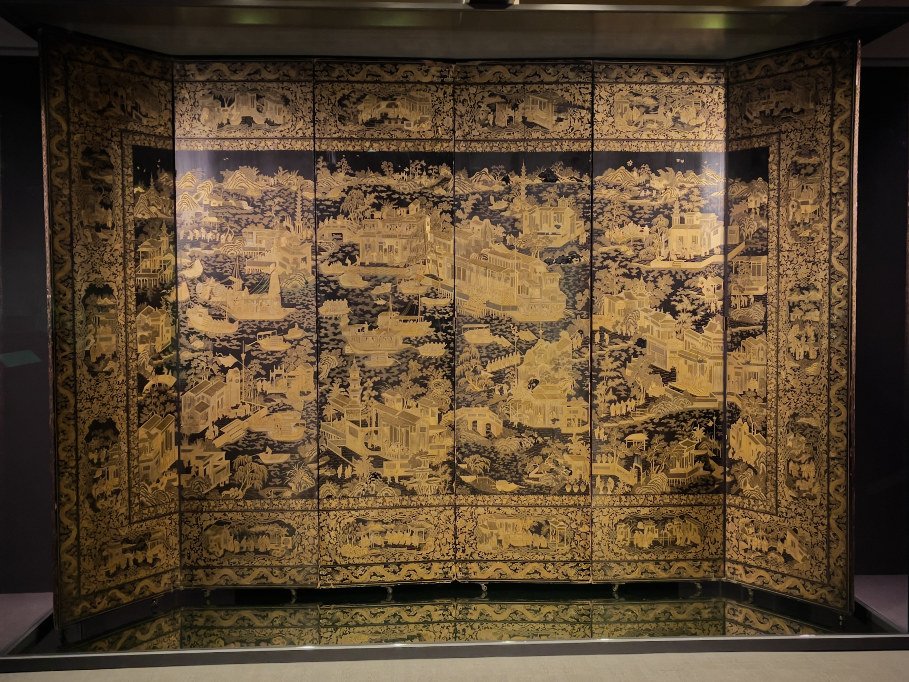
Black and gilt lacquer folding screen with narrative figures design, Late 18th – early 19th century, Lacquer
This folding screen turns lacquer into a theatrical surface. One side presents cityscapes, boats and pagodas among Lingnan dwellings and garden buildings, while the other shows opera scenes and narrative figures, creating a layered vision of Chinese life shaped for export.
Related Chinese motifs and patterns in art and culture of China
Black lacquer with gilt decoration was a signature Cantonese technique, and the combination of gold leaf and lacquer produced works that were especially prized in European royal and private collections. The screen embodies both pictorial density and international appeal.
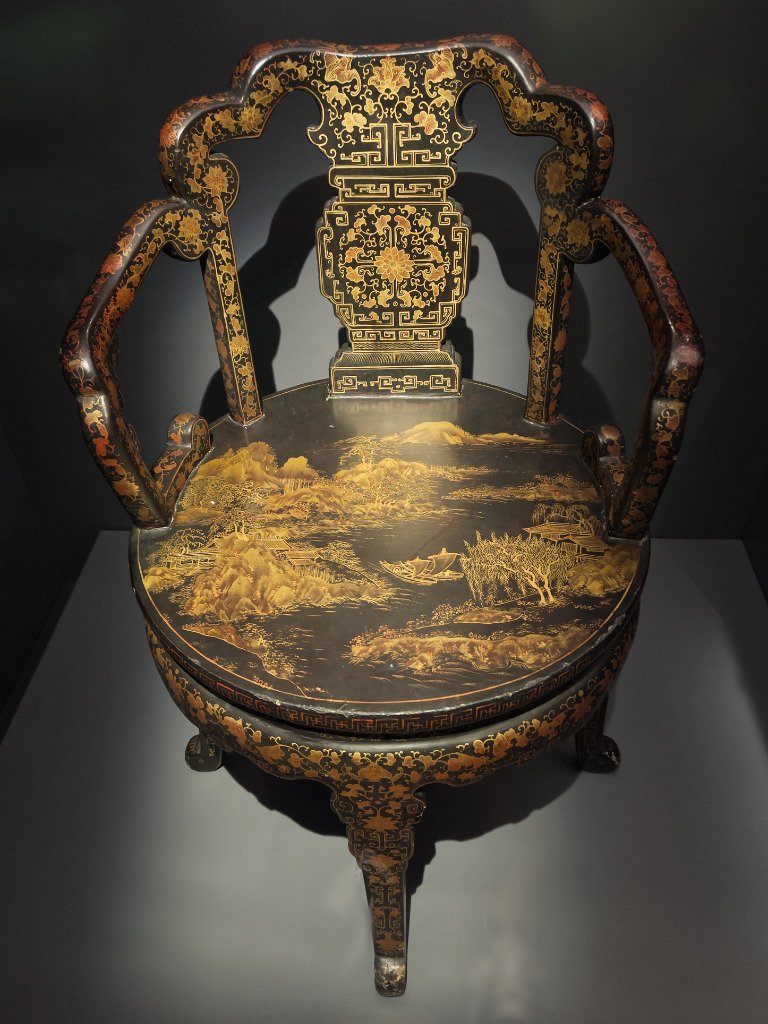
Black and gold lacquer armchair with lotus scrolls design, Qing dynasty (1644-1911), Lacquer
This armchair blends Chinese furniture forms with European Rococo influence. The horseshoe-back structure is familiar, but the carved backrest and armrests introduce a hybrid elegance that suggests how Cantonese design could absorb and adapt foreign taste.
Related Chateau de Versailles: Legacy of the Sun King
Its popularity was evidently broad, since comparable forms appear in early 20th-century export furniture catalogues. Here, style itself becomes evidence of circulation.
Guangzhou was a major centre of clocks and timepieces
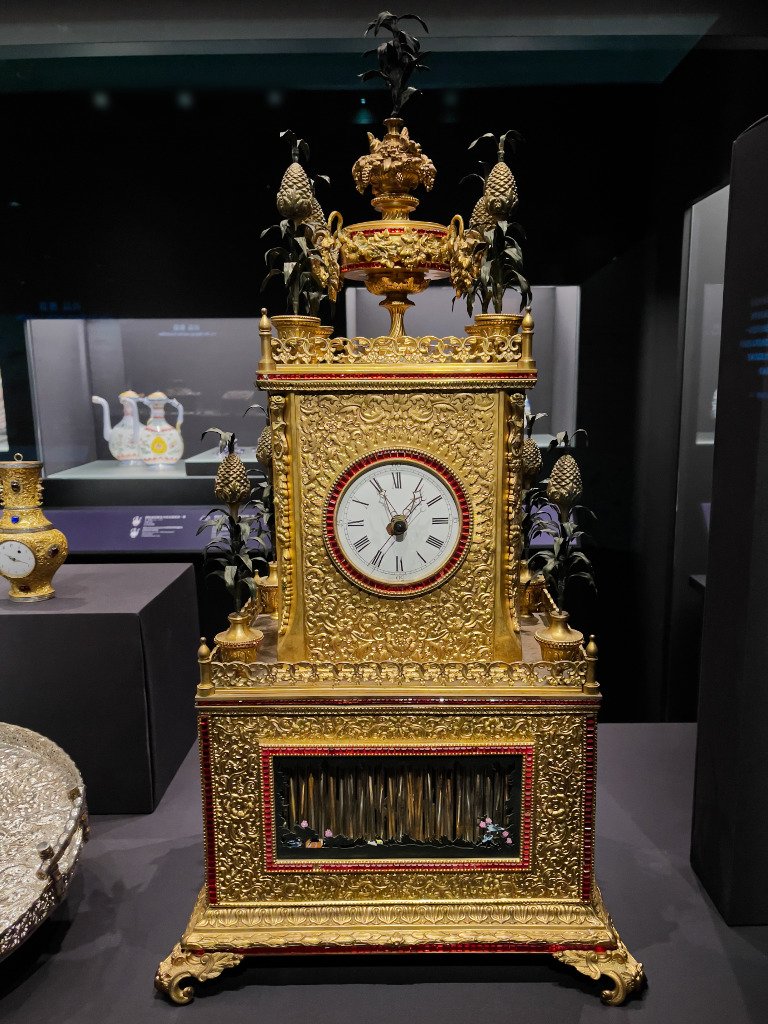
Gilt bronze clock with enamel and coloured glass inlay and waterfall features, Mark of “Cheong Smag Canton” in both Chinese and English characters, Second half of the 19th century, (Metal (gilt bronze) and glass
Timepieces remind us that Canton’s export culture was not limited to still objects. Guangzhou was a major centre of clock production during the Qing dynasty, and local workshops often combined mechanical ingenuity with elaborate ornament.
Related Treasures from the Forbidden City and Palace of Versailles
This gilt-bronze clock imitates European architecture while adding fountain forms, rotating pineapples, coloured glass, and water-automaton elements.
Related Treasures of the Mughal Court presents 100 examples from the golden age
The English and Chinese inscription naming “Canton” also shows how makers used foreign-looking marks to enhance prestige, folding global aspiration into the object itself.
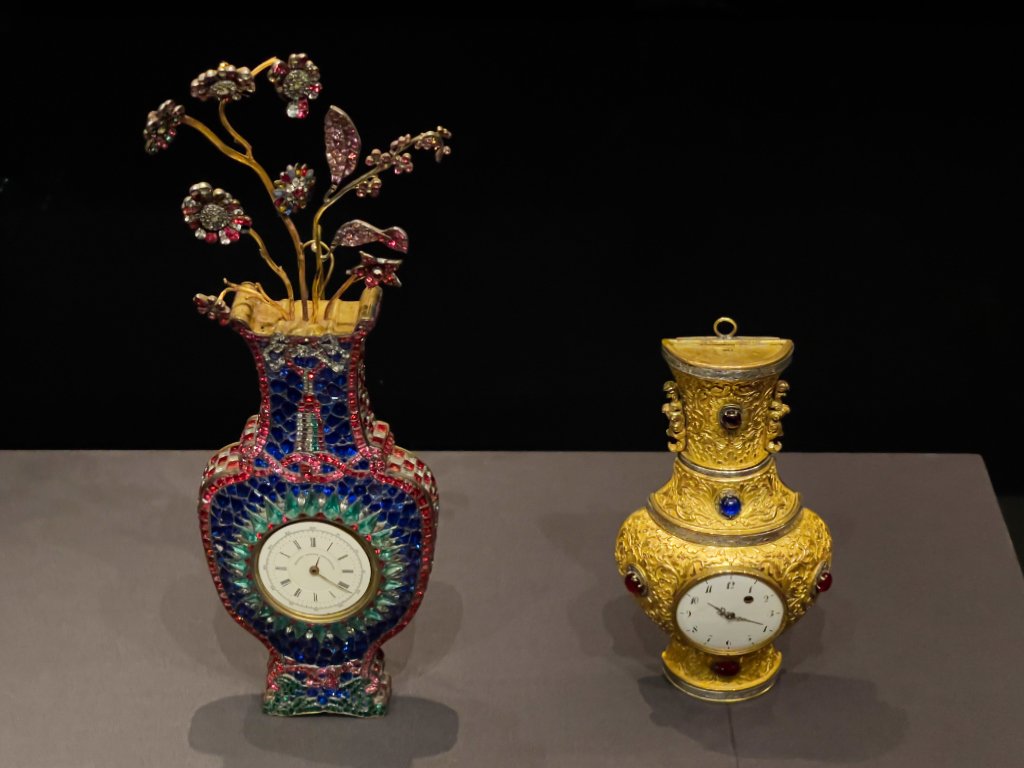
(left) Gilt bronze wall clock with coloured glass inlay, ca.18th century, Metal (gilt bronze) and glass, (right) Gilt bronze wall clock with design of lotus scrolls, Qianlong period (1736-1795), Qing dynasty, Metal (gilt bronze) and glass
Proudly from Canton makes a persuasive case for viewing Cantonese and export art as a major chapter in Chinese visual culture rather than a peripheral one.
Related Ancient dynasty currency and gold-like coveted Chinese Silk
Across silver, enamel, ivory, lacquer, textiles and paint, the exhibition shows how Guangzhou artisans created objects that travelled easily, delighted distant patrons and still speak powerfully today.
The collection also reflects Dr Simon Kwan’s conviction that art belongs in shared public memory. At the Hong Kong Museum of Art, these works now have a setting that allows them to be seen as treasures, and as witnesses to a long history of exchange, craft and cultural imagination.
Text & Photos Martin Wray


