
Irresistibly awesome ceramics from the imagination of Solan Chiu

Solan Chiu remains curious, playful, and fiercely independent

Galloping Dreamscape, 2025, Solan Chiu
Solan Chiu, founder of Giant Year Gallery
Master ceramic artist Solan Chiu has spent years forming her own style.
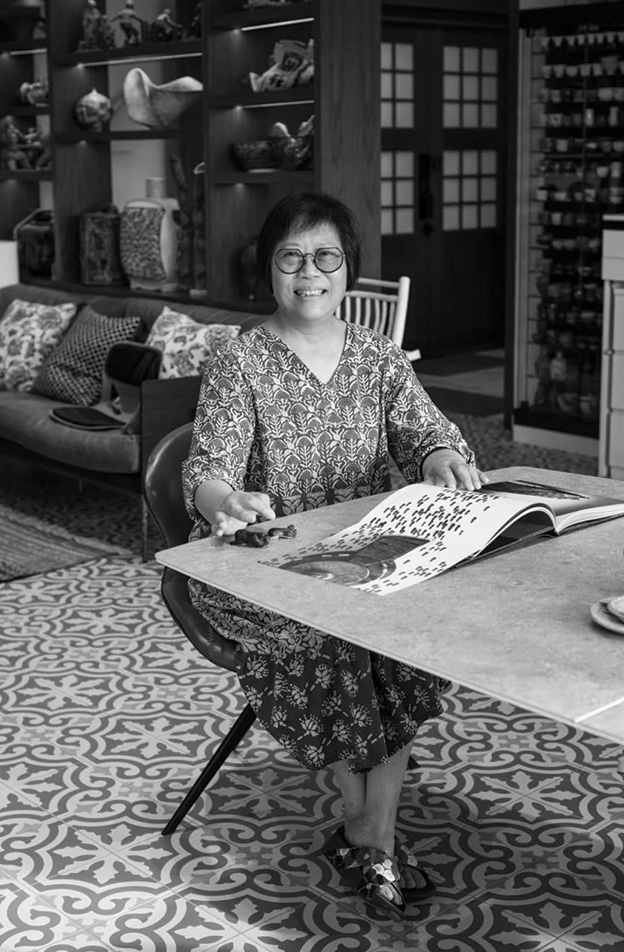
Solan Chiu at Giant Year Gallery, photo Zhou Sainan
She invents new ways to treat surfaces by using unexpected tools, bringing together old Chinese traditions and modern ideas.
As the founder of Giant Year Gallery, Solan does more than make art; she also supports young artists in Hong Kong.
Related Modern ceramic works by three emerging Chinese artists
She knows that real success takes both creative vision and smart business sense.
She remains curious, playful, and fiercely independent, all qualities that she has accumulated throughout her four-decade journey as a self-taught artist.

Looks like fish but not fish, 2024, Solan Chiu
“I haven’t formally studied under any teachers or masters”, she says, “I learned about ceramics from books and experimented on my own during my stay in New Zealand. That’s the reason my work carries no one’s shadow.”
Although she says her father did provide calligraphy instruction, she studied at the Hong Kong Visual Arts Centre and holds a Diploma in Chinese Calligraphy from the Hong Kong University.
Related Kings’ Inscriptions contemporary interpretations of traditional calligraphy
Her practice is indeed deeply personal, almost comparable to writing a biography shaped by clay and glaze.
Solan’s artistic evolution has been deliberate, from functional pottery to sculptures and large-scale installations.
Artistic journey shaped by familiarity and necessity
The transformation reflects her interest in narrative exploration and emotional expression beyond what is merely practical.
Solan’s artistic journey began in childhood, shaped by both familiarity and necessity.
Related Jubilant Childhood shown in Chinese Ceramics
Her father was a traditional Chinese ink painter, so early exposure to the creative world taught her a crucial lesson: art must be valued, and artists should be paid.
“I learned early on that creativity alone isn’t enough; you have to understand the business as well,” she explains.
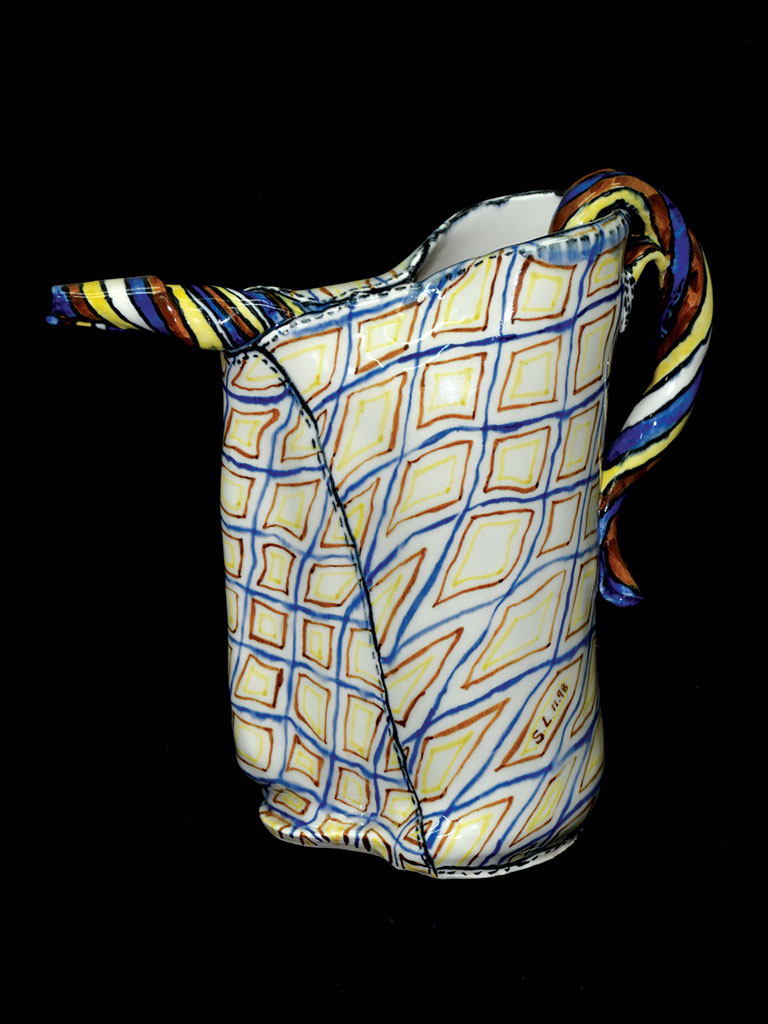
Silk Scarf Jug, 1997, Solan Chiu
To help support her family, she worked at home in small-scale craft production, such as beading or assembling plastic flowers.
Related Chinese Silk from the Qing dynasty stunning embroidery
These early experiences laid the foundation for the blend of artistic intuition and entrepreneurial vision.
Solan Chiu established Giant Year Gallery in 2012
She later established Giant Year Gallery in 2012, dedicated to showcasing ceramic art and nurturing young talent.
Related Inkgo Lam Uses Affordable Bamboo to Energize Beautiful Art
Living in Hong Kong, Solan finds much inspiration from the city’s people and spaces.

Solan Chiu Solo Exhibition at The Hong Kong University of Science and Technology, 2012
Her piece City Biscuits was born from a moment of observation.
Related Photographic memoir of Hong Kong by Lee Fook Chee
She remembers watching her son, among other white-collar office workers, waiting for the MTR, all facing the same direction, dressed in similar suits.
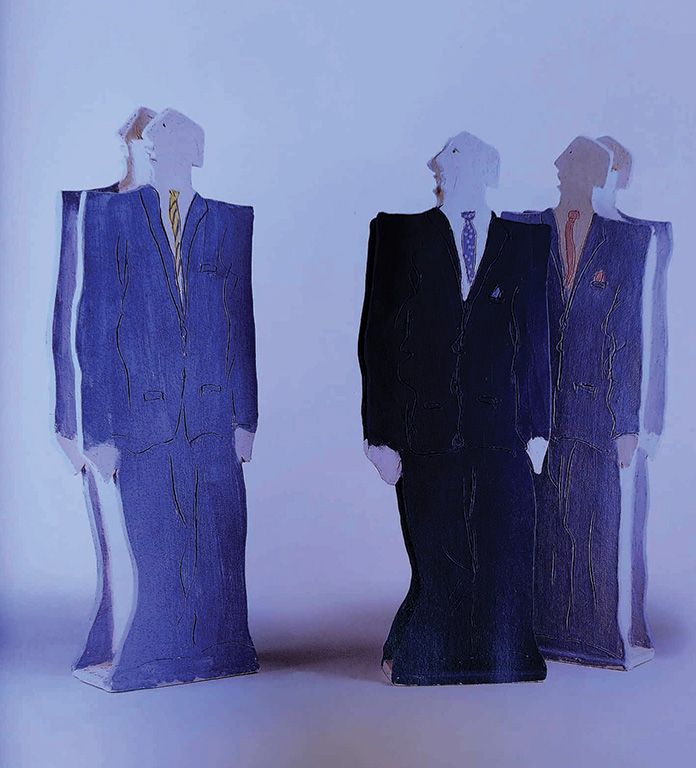
City Biscuits, 2004, Solan Chiu
“They looked like they were from the same cookie-cutter,” as she reminisces, perhaps of her child’s first entry into society.
Related Lego Art of the Brick more than a childhood pastime
“It reminded me of how the Hong Kong working class quietly accepts routine.”
In contrast, Crimson City captures the city’s vibrancy through a clutter of over thirty teapots and cups.
Related Beautiful Tea Pots and Ware by Hong Kong Potters
The fiery red colour glazing and selectively applied copper embellishments mimic the reflection of sunlight across the cityscape’s windows, echoing the warmth and intimacy of Hong Kong’s tea culture.
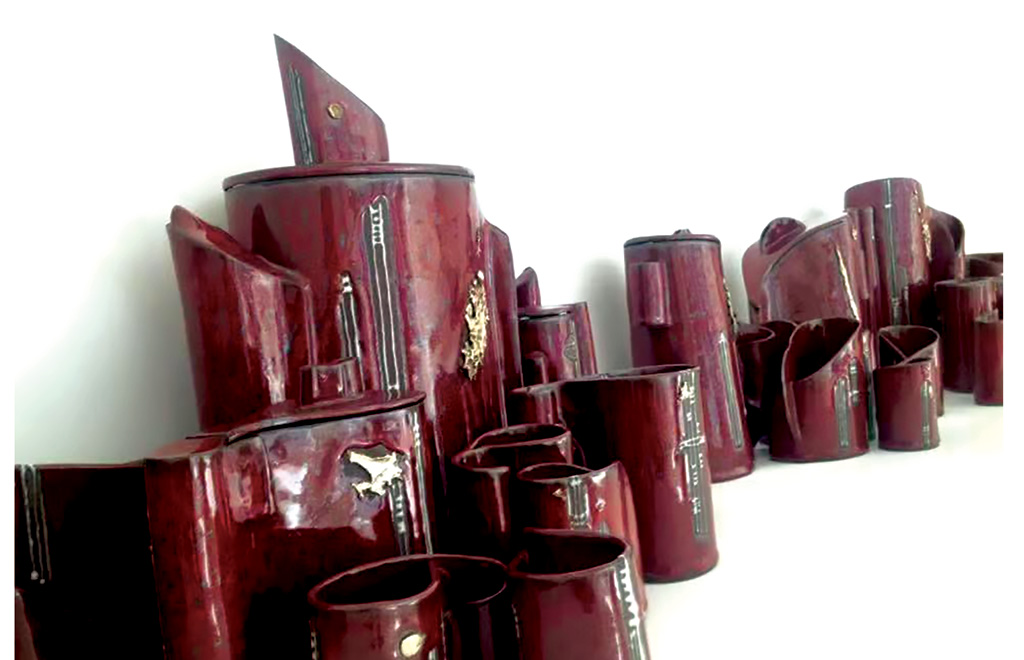
Crimson City, 2004, Solan Chiu
“Tea isn’t just about drinking, it’s about gathering, communicating and being present,” she declares.
Related Teahouses and dim sum tradition alive Hong Kong
Solan is deeply interested in Chinese history and poetry. Together with her expertise in Chinese calligraphy, this led to the creation of Bing Ju Xing, her most intricate installation to date.
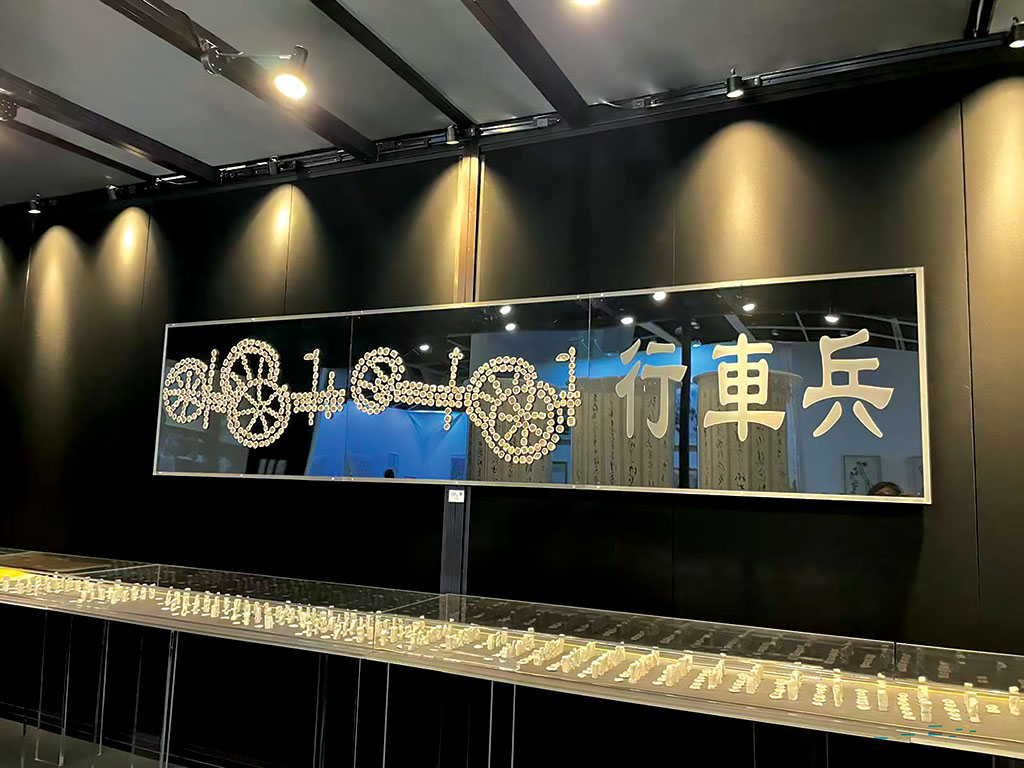
Bing Ju Xing, Fine Art Asia 2024, Solan Chiu
Inspired by ancient Chinese seal mud, which serves the same function as a wax seal, and stamp engraving techniques, the piece comprises over 380 components and took more than nine months to complete.
Related Chinese Blue and White porcelain from Yuan and Ming dynasties
The work was inspired by a poem by Du Fu of the Tang dynasty, which details a story from 729 C.E. of how Emperor Ming conscripted a hundred thousand men to defend the country against invasion, causing suffering and chaos in society.

Porcelain stamps and mud seals of Bing Ju Xing, Solan Chiu
Bing Ju Xing alludes to this poem with ceramic pieces poised like a troop of soldiers prepared for battle.
Related Tang dynasty golden age artistic highlights
“I always go all in while having fun,” her eyes lighting up as she describes the process. “I want to create visual impact through sheer volume.”
Visually striking installations
An almost identical piece, Ta Sha Xing, uses a smoke-firing technique to add more variations of colour on the surface.
Related Chinese contemporary artist Cai Guo-Qiang’s firework art
It was sold to a private collector in Singapore. Solan admits she was reluctant to part with it.
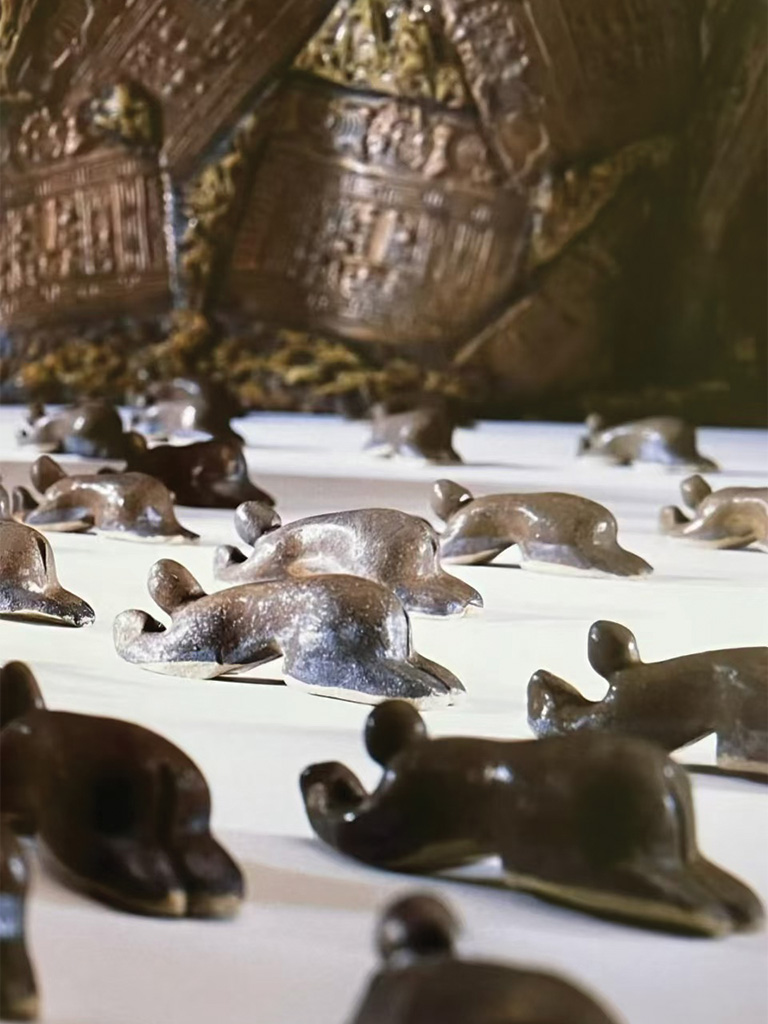
Regards, 2013, Collection of Macau Museum of Art, Solan Chiu
“They actually preferred Bing Ju Xing, but their office couldn’t fit it,” she laughs.
Another visually striking installation is Regards, composed of over 1,600 kneeling figurines.
Related Rosanna Li & Yeung Yuk Kan ceramic artworks
The worshippers surrounded a deity, who gazed down from above, divine, yet unable to intervene.
As the ancient saying goes, “Heaven helps those who help themselves.”

Solan Chiu Solo Exhibition at The Hong Kong University of Science and Technology, 2012
The piece gently suggests that rather than placing hope in external forces, we should find faith and the courage to initiate change from within.
Solan loves experimenting and has created her own dictionary of surface treatment using unconventional tools and self-made instruments.
Related Twentieth-Century Chinese Oil Paintings Across Time and Space
“My favourite place to shop overseas is the hardware store,” she says while pulling out different rods of length and width.
“My friends and I can spend hours discussing what each tool could do to clay.”
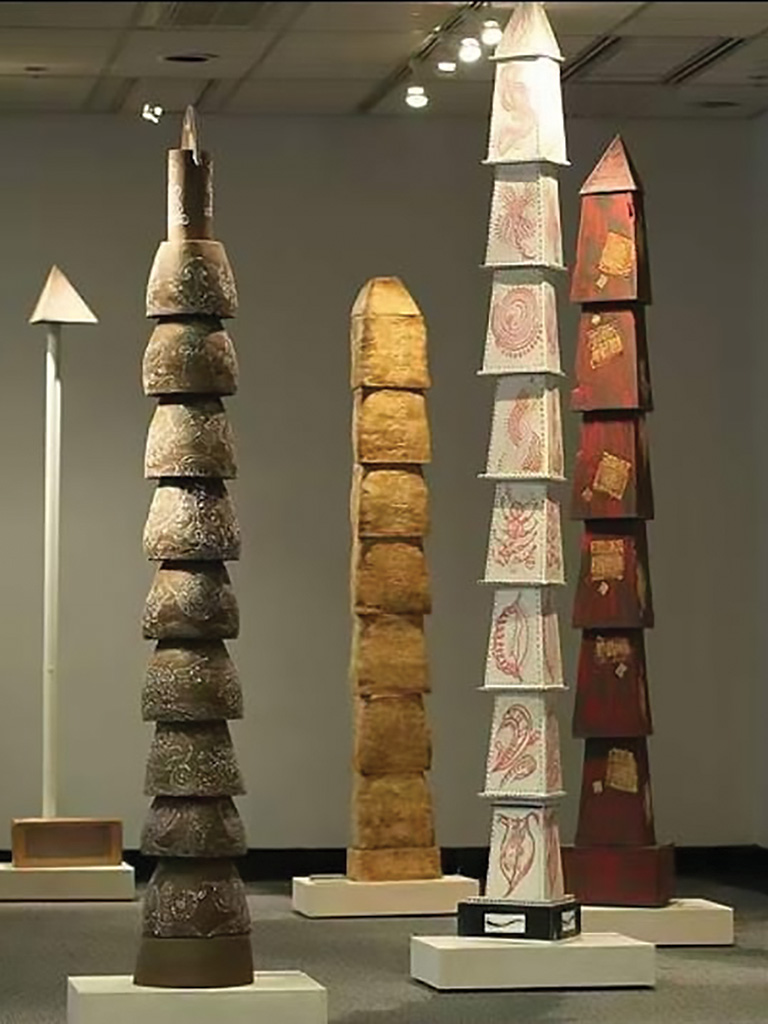
Blessing Pillar, 2012, Solan Chiu
For Blessing Pillar, she used an old Shanghai stamp with auspicious Chinese New Year blessings and characters to decorate the piece, which is a towering 222 cm in height.
Another method involves inlaying and laminating strips of coloured clay coils onto the surface, then burnishing them with pottery tools to create layered patterns.
Related Chinese motifs and patterns in art and culture of China
Other times, her use of colours is more spontaneous. Some works are earthy-toned, while others burst with rainbow hues.
“Colours just speak my emotions,” she says when asked if there are any with symbolic meanings to her.
Related Hong Kong remarkable art personalised masterpieces
Sometimes, she simply embraces the unpredictable nature of the glaze and stains.
Her style is still evolving. “I have so many ideas that my hands can’t keep up with my brain. That’s why I can never look back once a series is done.”
Related Hoo Mojong trailblazing Chinese female artist bridged East and West
The constant reinvention is a reason why viewers find it difficult to connect her earlier works with her recent ones.
A handful of her works remain untitled, deliberately left open to interpretation.

Contemporary Teabowls with Kafka faces, 2017, Solan Chiu
Yet when viewed as a whole, they are comprehensible.
In her Kafka series, whose surrealism resonates with her own approach, each piece feels like a dream – absurd in shape but fascinating in texture.
Related Surrealism beyond Mythologies
“I don’t always name them, because we have different experiences in life and see things differently”, she comments.
Solan is an avid reader. “I’m hungry for knowledge,” she says.
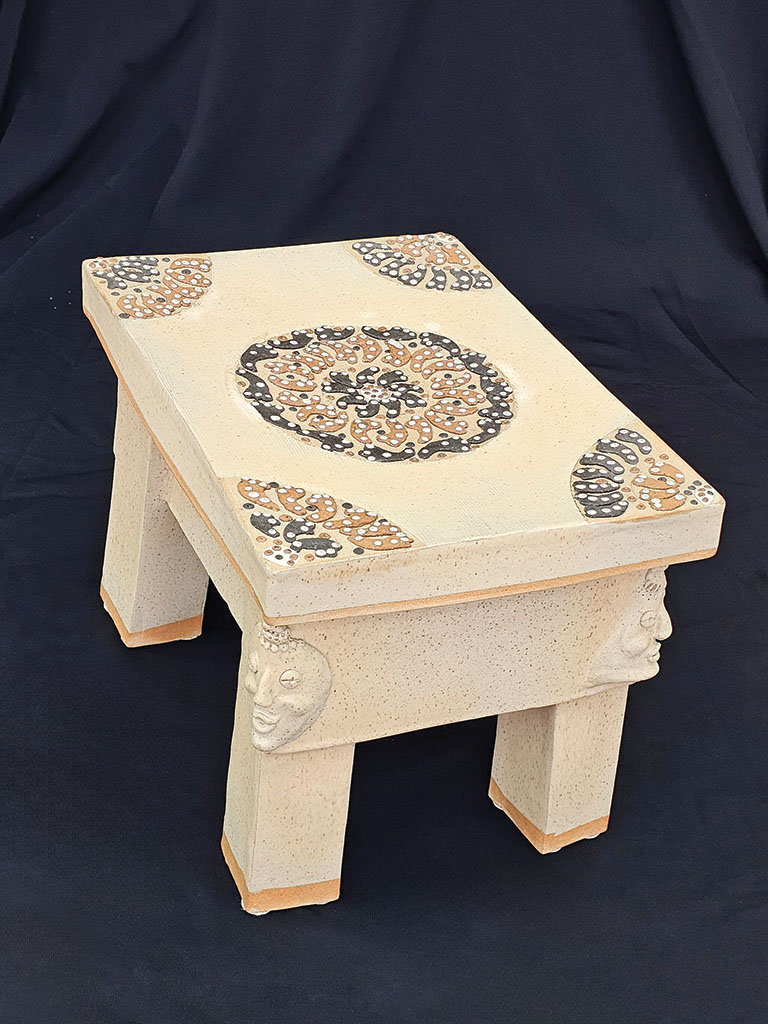
Inlaid stool with Kafka faced legs, 2019, Solan Chiu
Her studio was once lined with books, too many, she jokes, so that she had to send truckloads away.
Related Pioneering Picasso for Asia A Conversation
This thirst for learning and sharing knowledge extends to her community work. During the pandemic, she offered free pottery workshops to the elderly with no prior experience.
The result was “Zer0 – A Breakthrough,” a joint exhibition by teacher and students in April 2025.
Related 8 Qing dynasty art pieces featured with 8 modern artworks
“Most of them are retired and over the age of seventy,” she proudly gushes about the students’ effort and passion for creativity.
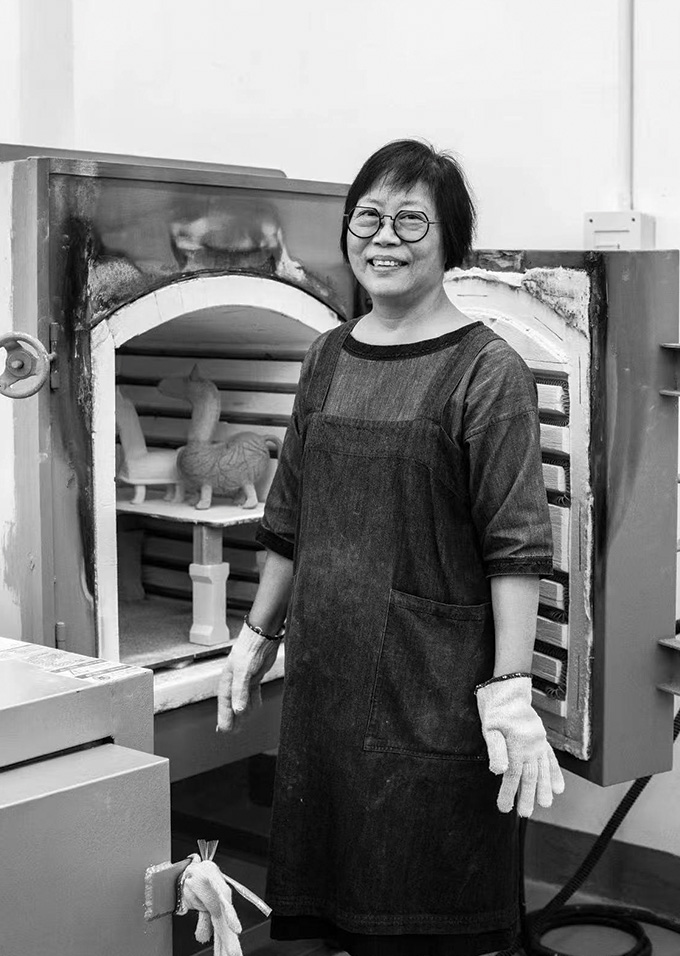
Solan Chiu at her studio, photo Zhou Sainan
This exhibition proved that it’s never too late to start learning a new skill – a testament to Solan’s ever-progressing artistic style throughout her career.
Related Sigg Collection 1990s Emerging Chinese Artists
On the day of our interview, I was lucky enough to witness the kiln opening, unveiling a firing of her newest works.
She presented the abstract horse figures one by one, with excitement and gentleness, showing some that were cracked.
Related Eddie Chau stunning vistas awesome artistic panoramas
“It’s natural,” she said with a smile, “ceramics teaches you to accept imperfection.” When all were lined up, they shared a naive expression.

A flying horse sculpture from Galloping Dreamscape, Solan Chiu, 2025
“I saw them in a dream,” she elaborates, “they were working hard, but slowly they became free, liberated!”
Maybe that’s herself, still hungry, still foolish, still moving toward the next breakthrough.
Related Daring and irresistibly new Chinese Calligraphy
I couldn’t help but notice how these horses resembled Chinese Sancai horses from the Tang dynasty (618-907 CE), predominantly glazed in brown, green, and yellow.
Related Ceramic treasures from the Tang dynasty
When Solan took them in her hands, I saw the link in her artistic journey, a bridge between Chinese antiquity, traditional crafts, and her contemporary sensibility, evoking a dialogue across time.
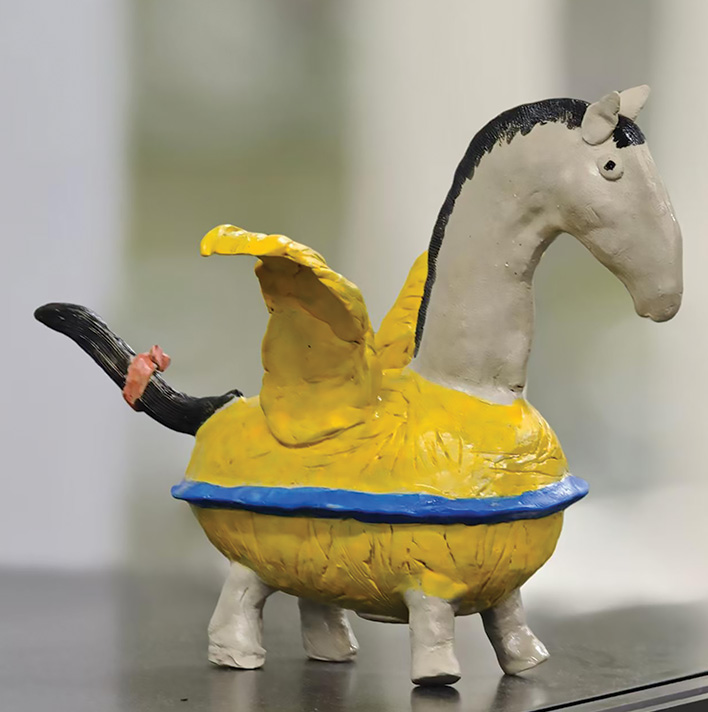
A flying horse sculpture from Galloping Dreamscape, 2025, Solan Chiu
These winged horses are part of her Galloping Dreamscape series and will feature in her second showing at the Personal Structures Venice Biennale show next year.
Related Donatello: One of the greatest Renaissance sculptors
After eight solo exhibitions and numerous joint shows, she has learned to stay calm and prepare well.
She is currently arranging an advanced trip to inspect the venue, allowing her to work on the curation and installation in person. “I’m lucky to have a supportive circle.
Related Pang Jiun’s monumental, vibrant hues and expressive marks
My late husband played a big role in my art publications and my group of friends who help with art administrations and logistics, so I can focus on creating,” she thankfully turned to her friend, who was also present during the interview.
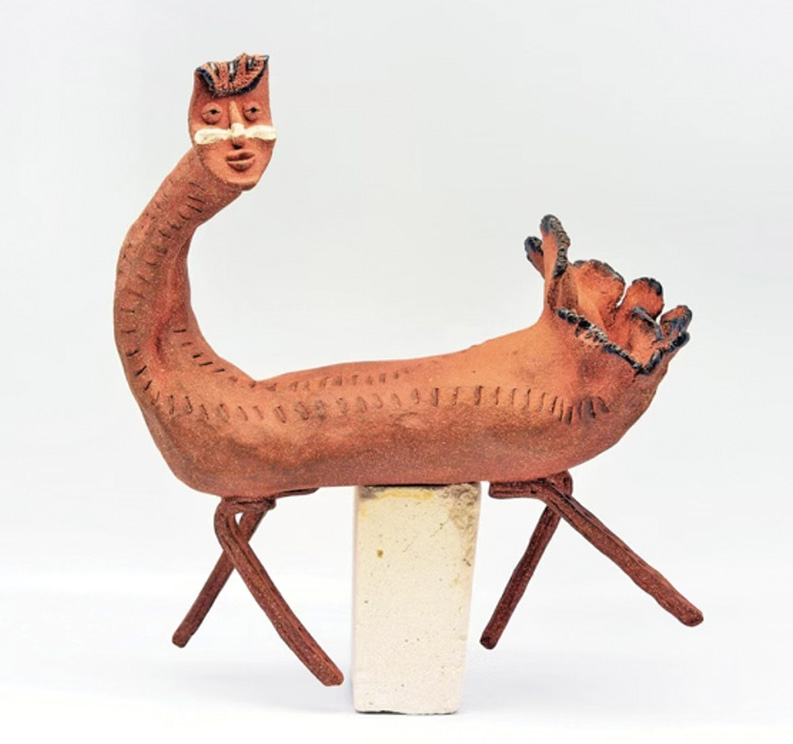
A Kafka sculpture, 2019, Solan Chiu
Despite the prestige of overseas exhibitions, from Asia to Europe, she recalls a disappointing outcome of one show in Japan.
“I spent so much effort preparing, but the attendance rate was poor. It reminded me that visibility and connection matter more than location.”
She still finds Hong Kong to be the most meaningful place to exhibit her work.
Related Hypnotic unique neon signs made in Hong Kong
“Here, I can express my needs and feelings freely. I tell young Hong Kong artists: opportunity belongs to those who are prepared. Although there are many difficulties working as an artist in Hong Kong. Don’t give up. Let people see the beauty of local ceramics.”
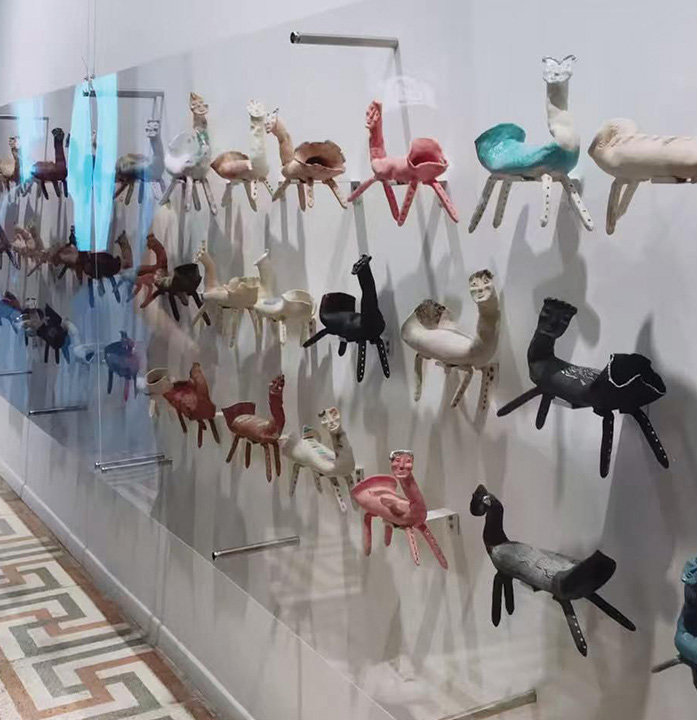
Kafka sculptures at the Personal Structures Venice Biennale show, 2019, Solan Chiu
When asked if she has a favourite piece, she pauses and replies, “No, because I still have so many ideas waiting to be created.”
She believes her most satisfying piece is yet to come. Her studio is immaculate, ready for the next burst of creation and sleepless nights.
Related Gold glitters in luxurious handmade ceramics linked by Jingdezhen
Though her physical condition may no longer allow her to work with large clay bodies, her spirit remains light.
To walk through her work is to unfold an unfinished book. And with her horses galloping to Venice, the next chapter is already underway.
Text Yi Bai / Photos Cammy Yiu and as attributed
See Solan Chiu’s artwork at:
Personal Structures, Venice Biennial Art Exhibition, 9 May to 22 November 2026
Personal Structures, Venice Biennial Art Exhibition, European Cultural Centre. Palazzo Michiel, Strada Nuova 4391, 30121 Venezia, Italy


