Rich Prize of Luxury and Power: Persia to Greece

Fabulous artefacts present link between Persia to Greece

Gold wreath © The Trustees of the British Museum
Luxury and Power: Persia to Greece
The British Museum’s special exhibition Luxury and Power: Persia to Greece explores history by shifting the focus from accounts of bloody battles to the study of less hostile materials of the Greek-Persian war.

Armlet with leaping lion-griffin tips, Gold, Takht-i Kuwad, Tajikistan, 500-330 BC
The Greek term tō politikōn, first introduced by the Greek historian Herodotus (c.484-425 BC), reflects the earliest invention of the domain of politics.
Related Chateau de Versailles: Legacy of the Sun King
People often like to believe that the political domain, or politics, fell from the skies one fine day in Pericles’ Athens in the miraculous form of democracy.

Panagyurishte Treasure, Athena © National Museum of History, Bulgaria
Long before the universal impact of Greek political structures, the Greek-Persian war was a turning point in Greek history.
Related Bronze Zodiac sculptures survived destruction of Old Summer Palace
The Persian court used luxury as an expression of prestige and power. However, Greeks who won the Greek-Persian wars condemned their barbarous enemy as weakened by luxury, proudly attributing their victory to a simple lifestyle.

Feminising luxury footbath, Wood with glass inlay, Egypt, 522-486 BC
Despite the political defeat, the distinctive Persian style culturally influenced democratic Athens and later the Hellenistic kingdoms.
Related Imperial portraits of luxurious life of Qing Emperors and Empresses
The magnificent ancient objects in the Luxury and Power: Persia to Greece exhibition, some original Persian artefacts alongside a myriad of Greek imitations of the Persian style, bear this out.

Gilded Silver Plate © The Trustees of the British Museum
The exhibition space is like a time capsule, whilst three distinct sections perform a comparative study: depicting opulent royalty in the Persian Achaemenid Empire, the ambivalent attitude of democratic Athens towards Eastern luxury, and Alexander the Great’s embrace of luxury after conquering Persia.
Related Ancient Chinese Gold symbol of power and wealth
Chronically, the first two sections focus on the fifth century BC including the half-century of the Greek-Persian wars, and the last section on the Hellenistic kingdoms since the third century BC.
Achaemenid Persia
The Achaemenid Empire, the first Persian Empire, was founded by Cyrus II “the Great” in 550 BC. At its height, around 500 BC, the empire was centred in modern Iran and stretched from Libya to Pakistan.
Related Odysseys of Art Masterpieces private Liechtenstein Princely art collection
The Achaemenid kings, therefore, adopted local titles and traditions to maintain their authority over a culturally diverse and vast empire. This included Egypt, which they ruled from 525 to 404 BC.

Panagyurishte Treasure, Aphrodite © National Museum of History, Bulgaria
A wooden door shows Darius I (c.550–486 BC) as an Egyptian pharaoh making offerings to Anubis and Isis deities.
Related Chinese Silk from the Qing dynasty stunning embroidery
Luxury goods poured into the court as tribute, including textiles, precious metal vessels, jewellery, and exotic animals.

Darius I as pharaoh, Wood with glass inlay, Egypt, 522–486 BC, British Museum
Governors, officials, and foreign envoys also brought gifts when they requested a royal audience.
Related The wealth and power of Romanov rulers of Russia
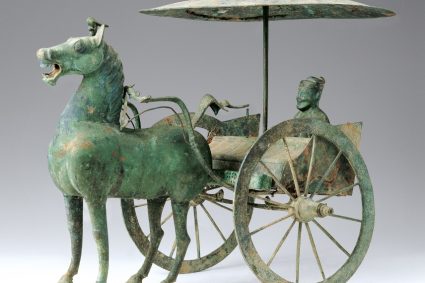
Persian courtiers were also known for their dazzling appearance, seated in chariots associated with authority and prestige.
Status symbols show the elite’s sumptuous wealth
Among the objects in this section, the Achaemenid rhytons, used as status symbols at sumptuous royal banquets, demonstrate the Persian elite’s way of drinking wine and foreshadow the next section of the Luxury and Power: Persia to Greece exhibition, in which the Athenian Symposium introduced and redefined this very Eastern way of drinking.
Related Mythical Sanxingdui creatures discovered in Sichuan
Competitive displays of wealth by rich Athenians contributed to tensions and violence.

Head of a bearded male worshipper, Limestone, Sanctuary of Apollo, Pyla, Cyprus 490–480 BC,
In response to growing social conflict, Cleisthenes introduced reforms in 508 BC to develop a democratic government, while displays of personal wealth were curtailed to contain social conflict.
Related Way of the Sword: Warrior Traditions in China and Italy
Many of the precious metal drinking vessels captured from the Persians were kept in the sacred treasuries of Athens as the property of heroes and gods, but they also inspired the production of clay cups in the shape of animal heads for ordinary Greek citizens.

Sphinx Drinking Cup © The Trustees of the British Museum
The humorous donkey cup, for example, transformed the drinker into a donkey.
Related Ceramic treasures from the Tang dynasty
Donkeys were rare in Persian art but were closely associated with Dionysus, the god of wine in Greece.

Lion head drinking cup © The Trustees of the British Museum
On Attic pots, however, the Athenians’ depiction of Persians in relation to Dionysus or the donkey during the Greco-Persian wars has a mocking tone compared to their pre-war depiction of Persians as noble warriors.

Persian drinking cup © The Trustees of the British Museum
The wars did not halt the change in Attic pottery. Several pots from different periods show how Athenian attitudes towards Persia evolved from around 510 to 380 BC.
Related Chinese Blue and White porcelain from Yuan and Ming dynasties
A flask from 380 BC shows that Persian depictions largely disappeared from Athenian artefacts about a century after the peace treaty. Traces of them survived in the form of mythical Eastern peoples.

Red-figured water jug © The Trustees of the British Museum
On the flip side of this democratic system, women had no formal political status and could indulge in luxurious displays without threatening the social order.
Related Chinese ancient people of Xia, Shang, and Zhou dynasties
The parasol, a symbol of the Persian king’s authority, became a feminine accessory, whilst Athenian women adopted Persian men’s eyeliner and jewellery styles.

Panagyurishte Treasure, Goat Rhyton © National Museum of History, Bulgaria
Meanwhile, up to 100,000 enslaved people lived in Athens, many from the Persian Empire.
Related British Museum History of the World in 100 Objects
Alexander III of Macedon (356-322 BC), commonly known as Alexander the Great, defeated the highly organised, centralised Achaemenid Empire that once ruled south-eastern Europe, the Middle East, and Central Asia and adopted the existing system of provinces.
Related Bold colours and magical magnificent Rajasthan
He also disregarded the notion that Persia was weakened by luxury and instead used it to project authority across this diverse world and win the loyalty of local elites.
Alexander the Great’s armies spread Greek customs
Carried east by Alexander’s armies and the Hellenistic kingdoms, local elites adopted Greek customs and adapted to local cultures.

Millefiori glass dish © The Trustees of the British Museum
A gold figure from Pakistan resembling the Greek goddess Aphrodite may represent the Buddhist protector Hariti.
Related Tian Tan Big Buddha bronze statue a colossal gift for people of faith
Hellenistic goddesses such as Fortuna and Tyche are also known to have served as prototypes for early images of Hariti.

Figure of a goddess and baby, Gold, Pakistan, About AD 100–300, Funded by the Brooke Sewell Bequest, British Museum
Several cities in the Hellenistic East developed as trading centres for precious materials such as gold, silver, and ivory.
Related Gold glitters in luxurious hand made ceramics linked by Jingdezhen
They also housed specialist craft workshops, often under royal patronage, where materials such as glass and faience could be transformed into luxury goods.

The Panagyurishte treasure, Gold, Panagyurishte, Bulgaria, c.350–275 BC
Nine gold Panagyurishte drinking vessels from Bulgaria are highlighted in this section. Bulgaria was once known as Thrace and was controlled by Persia from 513 to 511 BC.
Related Vatican Museums Raphael Renaissance artist contemporary of Michelangelo
Thrace acted as a bridge between Europe and Asia, and later Greeks settled in cities along the Black Sea coast of Thrace.

Panagyurishte Treasure, Stag Rhyton (1) © National Museum of History, Bulgaria
The Panagyurishte treasure is a mixture of Persian, Greek, Anatolian, and possibly Thracian styles.
Related Vatican Museum treasures and world’s most renowned works of art
These treasures may have been a diplomatic gift to a Thracian king, illustrating the political role of luxury in the Hellenistic period.

Gilt silver rhyton © The Trustees of the British Museum
In the section at the end of the Luxury and Power: Persia to Greece exhibition, only one animal-headed glass rhyton from the Roman period is on display, demonstrating that exotic goods associated with the East continued to confer status and prestige after the Romans overtook the Hellenistic kingdoms.
Related Rome ancient architecture and culture in Italy’s capital city
The opulence and luxury of ancient Persia, Greece, and the Hellenistic era continue to impact our modern attitudes towards prestige and wealth.

Panagyurishte Treasure, Hera © National Museum of History, Bulgaria
Whilst these objects were once symbols of power and decadence, their legacy persists despite the changes in political landscapes throughout history.

Panagyurishte Treasure, Phiale © National Museum of History, Bulgaria
The Luxury and Power: Persia to Greece exhibition presents thought-provoking arguments for the links between luxury and power and provides an opportunity to appreciate these artefacts’ beauty and their undeniable influence on our culture.
Text by Yang Jiang / Photo by Yang Jiang & The British Museum