Qin dynasty astonishing rise and disastrous down fall to Han

The Great Unity of the Qin dynasty and Han dynasty

Terracotta Kneeling Archer, Qin dynasty
Qin dynasty rise and fall
A curious mind is necessary to get the most out of exploring the chronicles of the rise and fall of the Qin dynasty and the emergence of the Han era at the Hong Kong Museum of History.

The exhibition has a grandiose title: The Great Unity: Civilisation of the Qin and Han Dynasties in Shaanxi Province.
Artefacts and historical treasures showcase the development of politics, economy, culture, technology and cross-border transportation during the Qin and Han dynasties.
Terracotta warriors and bronze chariots connect past
Life-sized terracotta warriors, bronze chariots, and priceless artefacts draw people in, but for those who want to connect with people from the past, understand their successes and failures, and truly appreciate their legacy, self-directed questions are required.
Related Bronze Zodiac sculptures survived destruction of Old Summer Palace
The exhibition title may not be poetic, but it does pose relevant questions like: What was the Great Unity? What is important about the Qin dynasty and the Han? And why is Shaanxi Province relevant?

Naked warrior & cavalry figurines, Han dynasty
Narratives of the Qin and Han in Shaanxi Province introduce a significant period of history that followed sequentially from the Xia, Shang and Zhou dynasties.
Related Majestic Han dynasty China’s first Golden Age
It is the second programme hosted by the museum to give audiences an understanding of the historical development and continuity of China’s history and culture.
Shaanxi Province origin of Qin dynasty
Shaanxi Province is pivotal, as this is where the Qin state established China’s first unified dynasty over two thousand years ago.

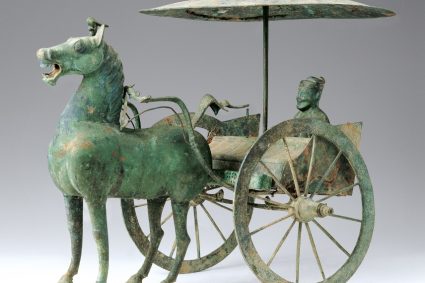
Bronze chariot No. 1 (replica), Qin dynasty, Originally unearthed from the Bronze Chariots and Horses Pit, Mausoleum of Emperor Qin Shihuang, Xi’an City
Both the Qin and Han dynasties built their capital cities in Shaanxi, and it is here that their emperors built their mausoleums from which many of the artefacts in this exhibition were excavated.
Silk Road connection
Shaanxi Province was also the birthplace and starting point of the Silk Road.
Related Maritime Silk Road Zodiac Heads from Old Summer Palace fountain clock
The Great Unity established a single, centralised and unified empire encompassing the previously fragmented and warring states of ancient China.
First emperor of China, Qin Shihuang
It was brought about by the conquest and reforms initiated by the first emperor of China, Qin Shihuang and refined by subsequent Han emperors.
Related Ancient dynasty currency and gold-like coveted Chinese Silk
This belies the magnitude of the Great Unity’s changes on every individual in China.

Painted pottery qi (tripod) & Painted double-eared pottery vessel, Warring States period
Before the Great Unity, during the Spring and Autumn period (771-476 BCE) and the Warring States period (Approximately 475-221 BCE), China was a crumbling feudal society because the king’s authority was no longer respected and individual lords acted as rulers of their own states.
Related Neolithic clues to Origins of Chinese Civilisation
These were times of constant war and loss of life, destruction of property, and disruption of agriculture and trade. For common folks, life was solitary, poor, nasty, brutish, short and miserable.
Emperor Qin Shihuang consolidated power to form Qin dynasty
An answer and a leader were desperately needed to escape these grim circumstances.
The solution came from the Qin state, which faced constant threats from nomadic tribes and needed to strengthen itself to survive and expand.

Ade bi (disc) with rush-mat pattern, Warring States period
The Qin grew powerful through centuries of strategic reforms, most notably those implemented by Shang Yang (390-338 BCE).
These reforms emphasised Legalism, a philosophy that promoted the state over all else by advocating strict laws, centralised administration, and providing incentives based on merit.

Silver ring holders, Warring States period
Ying Zheng (259-210 BCE) became the leader of the Qin state at the age of thirteen.
Related Way of the Sword: Warrior Traditions in China and Italy
In 221 BCE, he launched a series of successful military campaigns against the remaining six Warring States: Han, Zhao, Wei, Chu, Yan, and Qi.
Unification of all states into one China
He then unified all of China and declared himself Emperor Qin Shihuang, the first of China with powers above that of a feudal king.
Related Imperial portraits of luxurious life of Qing Emperors and Empresses
The Qin Emperor ended feudalism by nationalising the lands of the aristocracy of conquered states, forcing them to move to his capital city of Xianyang in Shaanxi, appointing bureaucrats based on merit, not birth, and strictly enforcing laws regardless of status.

Bronze garlic-headed vessel, Warring States period
He standardised weights, measurements, currency, the writing system and created a centralised bureaucracy to maintain and support these reforms.
Intellectual dissent was suppressed with a policy of “burning of the books and burying of the scholars” to banish ideas critical of Legalism, especially those associated with Confucianism.

Tile end with motifs of leopard, deer and fish, Warring States period
The first emperor of China was ambitious. He embarked on massive infrastructure projects to improve roads and canals.
Related Tale of 3 cities: Maritime Silk Trade in Guangdong – Hong Kong – Macau
He started building the Great Wall, expanded his capital city, and built grand palaces.

Painted cavalry figurines, Han dynasty
Qin Shihuang constructed a huge mausoleum, supposedly realistically representative of his entire empire, protected by a vast army modelled in terracotta, for his afterlife.
Related China history and Sanxingdui artefacts discovered in Sichuan
He implemented heavy taxation and forced labour to pay for these reforms and projects.
Qin dynasty died with Qin Shihuang death
These Qin reforms achieved the goals of improving agricultural output and bringing about peace, but the emperor’s extreme authoritarianism did not endear him to the population.
When Qin Shihuang died in 210 BCE, so too did the Qin reign and the short-lived dynasty.

Painted cavalry figurine with a shield, Han dynasty
There were four years of fighting before the Han rebel leader Liu Bang (256-195 BCE) sacked the city of Xianyang, executed the sitting Qin leader, ending the fifteen-year reign of the Qin dynasty and forging the rule by the House of Liu and the Han dynasty from 202 to 220 CE.
Related Lavishly luxurious life of Qing Emperors and Empresses of Yuan Ming Yuan
Liu Bang, posthumously named Emperor Gaozu, was more moderate than the Qin emperor. He maintained the reforms brought in by the Qin but lowered taxes and reduced forced labour. He also moved away from strict Legalism, allowing Confucianist practices.

Gold disc, Han dynasty
Liu Bang moved the capital city to Chang’an and oversaw its rebuilding and expansion near modern-day Xi’an in Shaanxi province. He also built a mausoleum for himself, of which artefacts in this exhibition were sourced.
Related Chinese Fragrance a Feast of Sensational Scents
Liu Che (156-87 BCE) became Emperor Wu of Han in 156 BCE. He is widely considered one of the greatest emperors of the Han dynasty.

Bronze zheng (musical instrument), Han dynasty
Geographically, he used his armies to double the size of the Chinese Empire. With these expanded borders, he was able to send envoys to Central Asia, establishing the Silk Road trade route.
Related Vibrant Silk Road commerce that changed China
It was Emperor Wu who formally adopted Confucianism as the state ideology and who established the Imperial Academy to train officials in the Confucian classics.

Bronze ding (food vessel), Spring and Autumn period
He laid the foundation for a Confucian-based civil service and shaped Chinese intellectual and political thought for the next two millennia.
Related Inkstones history, artistry, and passion of Chinese culture
He, too, had a huge mausoleum built for himself.

Terracotta Kneeling Musician, Qin dynasty
The Han dynasty endured 400 years compared to the Qin dynasty’s minuscule 15 years. However, combined, the new political systems these two dynasties put in place led to substantial development in economic production, culture and art, as well as technology and innovation.
Related Fantastic Chinese Blue and White Porcelain
Over an extended period of progress and advancement, the Han dynasty solidly unified and laid the foundations for Chinese society and culture.

Pottery domestic dog, Han dynasty
Their reverence for the burial custom of providing grave goods to the departed, to ensure a lavish welcome for them in the afterlife, is on display in the artefacts of clay models, including servants, livestock, musicians, and everyday objects like bowls and utensils, in the exhibition.
Related Amazing Auspicious Dragon
The belief in the existence of the afterlife and the provision of elaborate and plentiful burial goods was magnified during the Han period.

Gold chariot ornament, Qin dynasty
However, this practice was established in earlier times and is best exemplified by Emperor Qin Shihuang’s vast legions of terracotta warriors and horses.

Terracotta General, Qin dynasty
A few exquisite examples from the first emperor of China’s terracotta army are on display in this expansive story on the first and second dynasties of unified China.
Text Martin Wray and photos Cammy Yiu