Shanshui inspired by the tradition of ink paintings and the beautiful soaring expanse of nature

Ancient shanshui art techniques used in pursuit of alternate viewpoints of the natural world

Lamp (Oba-Q), Kuramata Shiro, 1972
Shanshui is an ideal of universal harmony
Inspired by the millennia-old East Asian tradition of shanshui ink paintings, the M+ exhibition, Shanshui: Echoes and Signals, blurs the line between the real and the imagined.

Cloud Mountain, Isamu Noguchi 1982–1983/2020
A myriad of mediums, from acrylic paintings to technical installations, ask the audience to reconsider how to engage with and explore their landscapes.
Art provokes us to see nature afresh, while technology acts as a lens that can either restrict or magnify our perception of it.
Related Masterful story-telling and development of Noir & Blanc art photography
Shanshui: Echoes and Signals asks if technology, despite its promise of connectivity, can truly bridge the gap between us and the natural world.

Scholar’s Rocks, 2013-2018, Chua Chye Teck
While the internet offers seemingly infinite connections, a loneliness epidemic is growing.
Related Stefan Irvine photos of Abandoned Villages of Hong Kong
It is all too easy to choose, emotionally distant online interactions over the messy complexities of real-life friendships.
This disconnect extends beyond human relationships; with a loss in touch of the physical world itself, with its unpredictable beauty, hidden dangers, and intangible rewards. Through art, shanshui offers a path to reconnect.
Related Pang Jiun monumental vibrant hues and expressive marks
Art, by its very nature, questions our perceptions of the world, and this exhibition encourages us to see nature with fresh eyes.

4PM, 2016, Sookoon Ang
The literal translation of shanshui is mountain water, an ideal of universal harmony that the best Chinese landscape painters try to capture.
3 key elements – mountains, rivers and occasionally waterfalls
The expression encourages a personal relationship with the land through philosophical thought and poetic imagery.

Landscape, 2007, Chen Guanghui
In this exhibition, works from Southeast Asian artists explore the convergence of yin and yang energies and the complicated relationship between people and nature through images, sounds and architecture.
Shanshui paintings include three key elements – mountains, rivers and occasionally waterfalls.
Related Vancouver Japanese Nitobe Memorial Garden
Largely influenced by Buddhist murals and woodcuts traded on the Silk Road, shanshui art first rose in prominence in the fifth century (early Tang dynasty) to express how we interact with the natural world.

(All is) non-hierarchical, 2022, Heidi Lau
Guo Cheng’s 2024 piece, Becoming Ripples, takes this communication further, using technology to create a dialogue between piece and person.
Related Silk Roads the greatest link of civilisations in the world
Composed of mirrored fabric, personalised hardware, stepper motors, and custom software, a hidden pre-programmed kinetic system causes the mirrored fabric to mimic ripples in the water.
Energies around us reinterpreted through Wesley Tongson landscape
Downward light conjures mountain silhouettes. By linking classical landscapes with the concept of the many different electromagnetic signals prevalent in our everyday lives, Cheng evokes how modern infrastructure is rooted in nature and how this technology constantly reshapes our environmental perceptions.

Gallery view of Shanshui Echoes and Signals Exhibition
The ultra-connectivity of our digital devices is powered by natural resources drawn from mountains and water, creating invisible signals that bind us together.
Hong Kong artist Wesley Tongson reinterprets the energies around us through his expressive landscape pieces.
Related Eddie Chau stunning vistas awesome artistic panoramas
Initially trained in traditional Chinese calligraphy, Tongson has deconstructed classic techniques to distil natural landscapes into expressions of pure energy. Spiritual Mountain 3, a creation of ink on paper, is visually evocative.

Spiritual Mountains 3, 2010, Wesley Tongson
While the forms he creates are only suggestive of landscapes, they are easily interpreted; fine lines depict soft, transient clouds, sturdy mountains are affixed with heavy splotches, signifying jungle growth, and rippling water is portrayed through repetitive wavy lines.
Related Lumbini Nepal birth place of Buddha World UNESCO Heritage
By deconstructing traditional techniques into their base concepts, his art creates a new perspective for viewers to consider the multiple levels of our environment’s interconnectivity.
Lee Ufan blurs the lines between natural and man-made in the style of shanshui
How do we reconcile between the natural and the constructed? Lee Ufan’s 2021/2024 piece, Relatum – The Mirror Road, challenges our senses and encourages us to take part in the balance between divine creation and that man-made.
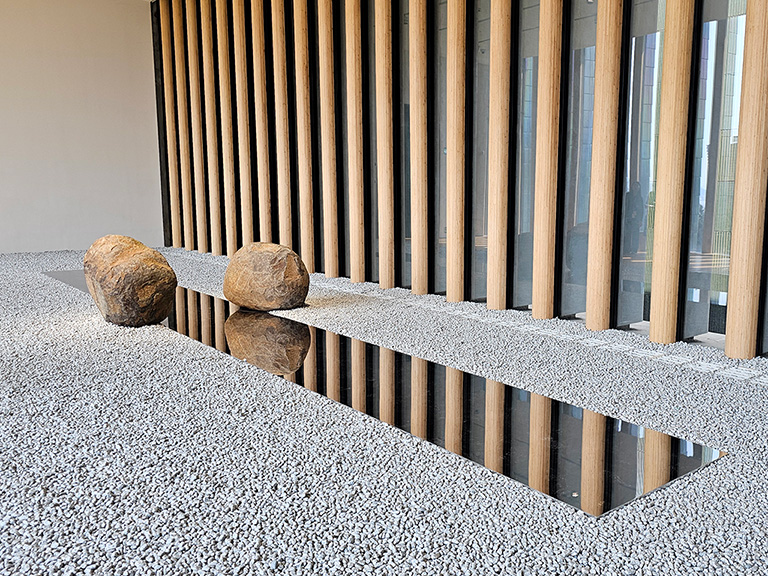
Installation view of Lee Ufan’s Relatum—The Mirror Road, (2021/2024)
In play with shape and scale, viewers are invited to interact with the installation by walking on the reflective path. Constructed of polished steel, the sleek path is surrounded by pebbles.
Halfway down, two natural boulders disrupt the uniformity of the installation, as does the viewer’s reflection in the work.
Related China’s most scenic city of Hangzhou
Ufan blurs the lines between natural and man-made creations. The polished steel path reflects the surrounding environment, creating a constantly shifting interplay between the environment and its creatures.

Left: Landscape, 2007, Chen Guanghui, Far Right: Sky-Land Expression #15, 2003, Wucius Wong
As viewers walk on the path, their own reflections disrupt the carefully composed scene, leaving ripples and distortions.
This impermanence is the point – Ufan uses it to remind us that we are part of a larger, interconnected whole, and our actions have ripple effects throughout the cosmos.
Related ZWO Astronomy Photograph of the Year 17
Through his work with video, painting and photography, Hebei-born artist Yan Lei uses art to examine Eastern and Western dynamics and consider varying approaches to authority.

Black & White Mustard Seed Garden (Tale of the 11th Day Series), 2009-2014, Yang Jiechang
Viewing painting as a “mindless re-presentation of an image you might see in a photograph”, he takes a new approach.
Yan Lei uses art to examine Eastern and Western dynamics
Huang Shan, an acrylic painting of Mount Huang, dissolves reality into abstract forms. The richness of the environment is muted into greyscale, and details are blurred together, making the natural landscape at once familiar and alien.

Huang Shan (Mount Huang), 2002, Yan Lei
Another piece of his, Monkey, is constructed in the same style. When approached without context, viewers can trust basic visual cues to accurately guess the subject is a monkey traversing the terrain on all fours, but the vagueness of the image provides no clues to the monkey’s mood, the reason for travelling, nor the location, all which need to be filled in by an inquisitive viewer.

Monkey, 2003, Yan Lei
Miyajima Tatsuo installation of LED counters represents the cycles of life and death
The past is a story we tell ourselves; what is to be can only be imagined. Japanese artist Miyajima Tatsuo explores this concept of time’s endless nature and of reincarnation.
Related Ukiyo-e Japanese wood block prints of Utagawa Hiroshige
His installation of two hundred LED counters represents the cycles of life and death.

Region No. 43701–No. 43900, 1998, Miyajima Tatsuo
Titled Region No. 43701-No. 43900, the extensive circuitry endlessly flashes the numbers one to ninety-nine in greens and reds, with counters restarting at one after they’ve hit ninety-nine.
It is a physical representation of the Buddhist concept of samsara, the ongoing nature of reincarnation.
Related Tian Tan Big Buddha bronze statue a colossal gift for people of faith
Interestingly, numbers that include a nine are omitted from the sequences for their finality and personal meaning of emptiness to the artist.

Gallery view of Shanshui Echoes and Signals
The eerie glow of the ever-counting counters bathes viewers in a deep red light, giving a physicality to the ethereal passage of time.
Yang Xinguang compare the impact of nature versus human intervention
Time inevitably passes, but we can change our surroundings. Exchanges between people and nature can be an active dialogue, action and reaction, or dominance and control.
Related Kowloon Walled City of Darkness vintage photos
Hunan artist Yang Xinguang asks visitors to compare the impact of nature versus human intervention in his 2007 work, Xie Ju (The Way of the Measured).

Xie Ju (The Way of the Measured), 2007, Yang Xinguang
Formed of river rocks, he gives the natural and the constructed equal weight. His examination is led by the Confucious belief that raw materials are representations of human nature.
By mastering nature, one takes on the act of character building. Yang uses oddly shaped river rocks to form a circle.
Related Vintage photos of Victoria Harbour and old Hong Kong
In contrast, he polishes and positions the remaining river rocks to create a neat square mosaic of cubes and rectangles.

By the Mountain, By the Water, 1990, Chen Jialing
The primary shapes are a clear marker of the natural – the circle – and the constructed – the square – as Yang invites viewers to consider how we interact with the natural world.
Related German Society Nature Photography of 2025
Inspired by the millennia-old East Asian tradition of shanshui ink paintings, Shanshui: Echoes and Signals, blurs the line between the real and the imagined.
A myriad of mediums, from acrylic paintings to technical installations, ask the audience to reconsider how to engage with and explore their landscapes.

Water Reflection, 2022, Nicolas Party
Beyond visually considering each piece, the artists ask us to open our senses of sound and touch to become more immersed when interacting with nature.
Related Treasures from the Forbidden City of the Ming and Qing dynasties
Far from an antiquated art form, these artists show that the concept of shanshui can exist in many forms, reminding us of our connection to the natural world.
Text Victoria Mae Martyn / Photo Cammy Yiu