
Snuff Bottles the most lavishly made in the world

Fuyun Xuan is one of the most renowned collections of Chinese snuff bottles

Double-gourd-shaped jade snuff bottle carved in the round, Qing dynasty (1644-1911) Jade (spinach-green jade)
Fuyun Xuan Collection
The Fuyun Xuan Collection is one of the most comprehensive and renowned private collections of Chinese snuff bottles in the world.

Snuff bottle with fish and lotus design in red overlay on snow-white ground Qing dynasty (1644-1911), Glass
Established in 1989 by the late Hong Kong collector Christopher Sin, these 490 sets of snuff bottles provide a window into the artistry, craftsmanship, and cultural significance of Chinese snuff bottles spanning over three centuries.
Related Chinese art from the collectors of the Min Chiu Society
The use of snuff in China began after tobacco arrived with European traders in the late 16th century and gained royal sanction under the Qing dynasty, whose rulers prohibited smoking but endorsed snuff for its medicinal properties. This led Chinese physicians to dispense finely ground tobacco from small bottles, much like other remedies.
Under the Kangxi Emperor (1661-1722), snuff bottles became coveted court objects after Jesuit missionaries presented them to the emperor.
Related Maritime Silk Road Zodiac Heads from the Old Summer Palace fountain clock
Their symbolic role as refined status markers spread from Beijing’s elite to northern gentry social rituals.

Pair of translucent blue glass snuff bottles with landscape design and Qianlong marks, Qianlong period (1736-1795), Glass
By the late eighteenth century, snuff bottles had permeated all strata of Chinese society: offering snuff evolved into polite custom.
Related Chinese paintings by prolific artist: Wu Guanzhong
Extraordinary bottles conferred prestige, and they even served as diplomatic gifts and political bribes, prompting mass production of vessels ranging widely in craftsmanship to satisfy the empire’s growing demand.
The historical momentum from court patronage and regional workshops to widespread popular demand laid the groundwork for the remarkable variety now showcased in the Fuyun Xuan Collection.
Related Chinese Silk from the Qing dynasty, stunning embroidery
By tracing the art form’s journey through glass, jade, lacquer, ceramics, metal, and organic media, the collection captures every phase of innovation and artistry that transformed snuff bottles from functional medicine containers into celebrated masterpieces of Chinese craftsmanship.
Snuff Bottles: Material mastery and artistic achievement
This exhibition is organised into sections, each representing a different aspect of material mastery and artistic achievement.
Related Celebrating the Year of the Snake artefacts
One section: Refined Materials – Glass, showcases the sophisticated glassmaking techniques developed in Chinese imperial workshops during the Qing Dynasty.
This extensive category includes pieces demonstrating the remarkable diversity of Chinese glass artistry.
Related Chinese Reverse Glass Painting from the Mei Lin Collection
Featured techniques include aventurine glass with gold-flecked surfaces, overlay glass with intricate carved designs in multiple colours, and painted enamels that demonstrate the influence of European artistic techniques on Chinese decorative arts.

Aventurine glass snuff bottle with chi dragons and shou medallion design Qianlong period (1736-1795), Glass
Notable examples include a Qianlong-period Aventurine glass snuff bottle with chi-dragons and shou medallion design, which demonstrates the technical mastery achieved in imperial workshops.
Related Year of the Dragon celebrated with stunning watercolour & video
The collection also features complex multi-coloured overlay techniques, such as the white gourd with red overlay bottles showing narrative scenes like “searching for plum blossoms in the snow” and literary inscriptions with poetic verses.
Imperial marks denote imperial patronage
The glass bottles demonstrate imperial patronage through their imperial marks, including pieces bearing the “Qianlong year mark” and “Daoguang year mark”, as well as other reign marks that authenticate their production during specific imperial periods.
Related Qing dynasty garden paradise, Yuan Ming Yuan, a jewel of Chinese history
The sophisticated colour palette ranges from translucent purples and blues to opaque reds imitating coral, showcasing the mastery of glass colouring techniques.

Snuff bottle carved with bosses design, Qing dynasty, (1644-1911), Lapis lazuli
A second section: Refined Materials – Jade and Minerals, encompasses pieces crafted from various precious materials, demonstrating the Chinese reverence for jade and other precious stones.
Related Treasures from the Tang dynasty
The collection includes bottles made from multiple types of jade: white jade, yellow jade, celadon jade, black jade, and spinach-green jade, as well as jadeite, rock crystal, amethyst, tourmaline, agate, and lapis lazuli.

Snuff bottle highlighting natural patterns, Qing dynasty (1644-1911), Moss agate
The section features both traditional Chinese carving styles and Mughal-influenced designs, highlighting the cultural exchange that influenced Chinese decorative arts during the Qing Dynasty.
Related Treasures of the Mughal Court presents 100 examples from the golden age
Notable pieces include a jade bottle with four pierced loop handles bearing the Jiaqing year mark and Mughal-style white jade bottles with lotus scroll designs that demonstrate the cosmopolitan nature of Qing court taste.

Snuff bottle with four pierced loop handles and Jiaqing mark, Jiaqing period (1796- 1820), Jade (yellow jade)
The collection includes exceptional examples of cameo carving and relief work, where artisans utilised the natural variations in stone colour and patterns to create sophisticated decorative schemes.
Related China history and the Sanxingdui artefacts discovered in Sichuan
Imperial workshop pieces are distinguished by their technical perfection and imperial marks, while regional variations demonstrate the diversity of jade-working traditions across China.
Perhaps the most technically demanding category, Refined Materials – Cameo Carving, contains snuff bottles that demonstrate the Chinese artisan’s ability to work with the natural colours and patterns of stones to create multi-layered narrative scenes.
Related British Museum Silk Roads movement of people and ideas that changed the world
These bottles showcase the pinnacle of qiaose technique, where craftsmen utilise the natural colour variations in jade and agate to create sophisticated compositions.

Snuff bottle carved with sage crossing bridge and plum blossom design, Qing dynasty (1644-1911), Chalcedony
The collection includes masterful examples of storytelling through stone, with literary and historical themes carved into jade and chalcedony.
Related Van Mieu is the old Temple of Literature in Hanoi
Notable pieces include white jade bottles depicting classical literary scenes such as “Mi Fu inscribing on a rock” and “Wang Xizhi exchanging calligraphy for geese”.

Snuff bottle with “Mi Fu inscribing on a rock” design, Qing dynasty (1644-1911), Jade (white jade)
The chalcedony bottles feature sophisticated narrative scenes with inscribed poems and seals, such as the bottle sage crossing bridge and plum blossom design.
Related Beautiful Tea Pots and Ware by Hong Kong Potters
The technical mastery displayed in these pieces transforms humble materials into sophisticated works of art that combine narrative content, poetic inscriptions, and technical virtuosity in miniature format.
Bottles made from humble materials
Refined Materials – Organic Materials showcases bottles made from coral, amber, ivory, rhinoceros’ horn, mother-of-pearl, lacquer, bamboo, gourd, and even coconut shell.
Related Jubilant Childhood scenes captured in ceramics by 3 artists
The use of these organic materials demonstrates the diversity of materials used by Chinese craftsmen.

Cinnabar lacquer snuff bottle carved with figures in a pavilion design, Four-character mark of Qianlong (1736-1795), Qing dynasty, Lacquer
These pieces often feature intricate carving and inlay work that transforms organic materials into objects of extraordinary beauty.
Related Inkstones history, artistry, and passion of Chinese culture
The lacquer bottles include examples of cinnabar lacquer carved with pavilion scenes bearing Qianlong period marks and painted lacquer with gilt decoration.

Openwork snuff bottle with figures on boat design and Qianlong mark, 18th century, Ivory
The moulded gourd bottles feature impressive designs, including chi-dragons holding shou characters with Daoguang period marks.
Related Amazing Auspicious Dragon
Notable inlay work is demonstrated in coconut shell bottles with ivory inlays depicting figural narratives and historical scenes.

Moulded gourd snuff bottle with chi-dragon holding shou character design and Daoguang mark Daoguang period (1821-1850), Gourd
The section includes examples of carved coral bottles with dated inscriptions, such as a bottle carved with “searching for plum blossoms in the snow” from 1847/1907 with poetic inscriptions.
Related Artists’ books best and devastating art and poetry
The diversity of organic materials represents the Chinese artisan’s ability to transform any suitable material into sophisticated decorative objects.

Snuff bottle carved with “searching for plum blossoms in the snow” design, 1847/1907, Coral
Refined Materials – Processed Materials, including ceramics from famous kilns, painted enamels, and metal bottles.
Related Contemporary ceramics from the imagination of Solan Chiu
These items, made of processed materials, show how traditional Chinese techniques were adapted for snuff bottle production.

Snuff bottles in the form of a lady in fencai enamels, Qing dynasty (1644-1911), Ceramics
This section includes both imperial workshop pieces and regional variations, demonstrating the widespread production of snuff bottles across China.
Related Gold glitters in luxurious handmade ceramics linked by Jingdezhen
The Yixing ceramic bottles feature slip-decorated landscapes and painted enamel decoration.

Cabbage-shaped snuff bottle in fencai enamels, Qing dynasty (1644-1911), Ceramics
Imperial porcelain bottles include pieces with fencai enamels, underglaze blue decoration, and doucai enamels bearing various imperial marks from the Qianlong through Guangxu periods.
Related Chinese Ceramics Blue and White Porcelain
Notable painted enamel glass bottles bear marks of famous workshops, including “Guyue Xuan”, and demonstrate the highest levels of miniature painting on glass surfaces.

Snuff bottle with katydid design in fencai enamels, Daoguang period (1821-1850), Ceramics
The section also includes metal bottles with painted enamel decoration and engraved designs, representing the full spectrum of Chinese decorative arts applied to snuff bottle production.
Related Luxurious and Beautiful Legacy of Chinese Silk
The tradition of inside painting represents one of the most technically challenging forms of Chinese decorative art.

Copper snuff bottle with flowers and birds design in painted enamels, Qianlong period (1736-1795), Metal (copper), Four-character mark of Qianlong
Inside painting required artists to paint intricate scenes inside transparent bottles using specially designed brushes inserted through narrow openings.
Related Twentieth-Century Chinese Oil Paintings Across Time and Space
This demanding technique reached its artistic pinnacle during the Beijing School period between 1890 and 1945.

Snuff bottle inside-painted with autumn insects design, Zhou Leyuan (act. 1882 to 1893), Late 19th century, Glass
Four master artists: Zhou Leyuan (1853-1930), Ding Erzhong (1865-1930), Ma Shaoxuan (1867-1939), and Ye Zhongsan (1869-1945) elevated the craft to unprecedented heights.
Related Pang Jiun monumental, vibrant hues and expressive marks
Among the collection’s most significant treasures are works by three of these Four Great Masters, showcasing the extraordinary skill and artistic vision that defined this golden age of inside painting.

Snuff bottle inside-painted with portrait of Yin Chang, Ma Shaoxuan (1867- 1939), Early 20th century, Rock crystal
The collection features a rock crystal snuff bottle, inside painted with a portrait of Yin Chang from the early twentieth century by Ma Shaoxuan.
Related Imperial portraits of the luxurious life of Qing Emperors and Empresses
He was one of the most technically accomplished artists of the Beijing school, renowned for his monochromatic portrait bottles.

Snuff bottle inside-painted with portrait of Ma Shaoxuan, Liu Shouben (1943-2022), 1992, Rock crystal
Ma Shaoxuan’s bottles with portraits of leading Qing officials, executed with photographic precision using only black ink and vermilion for seals were renowned.
Related Qing dynasty Zodiac sculptures from Old Summer Palace
His technical mastery and ability to capture perfect likenesses made him one of the most celebrated artists of the Beijing School.
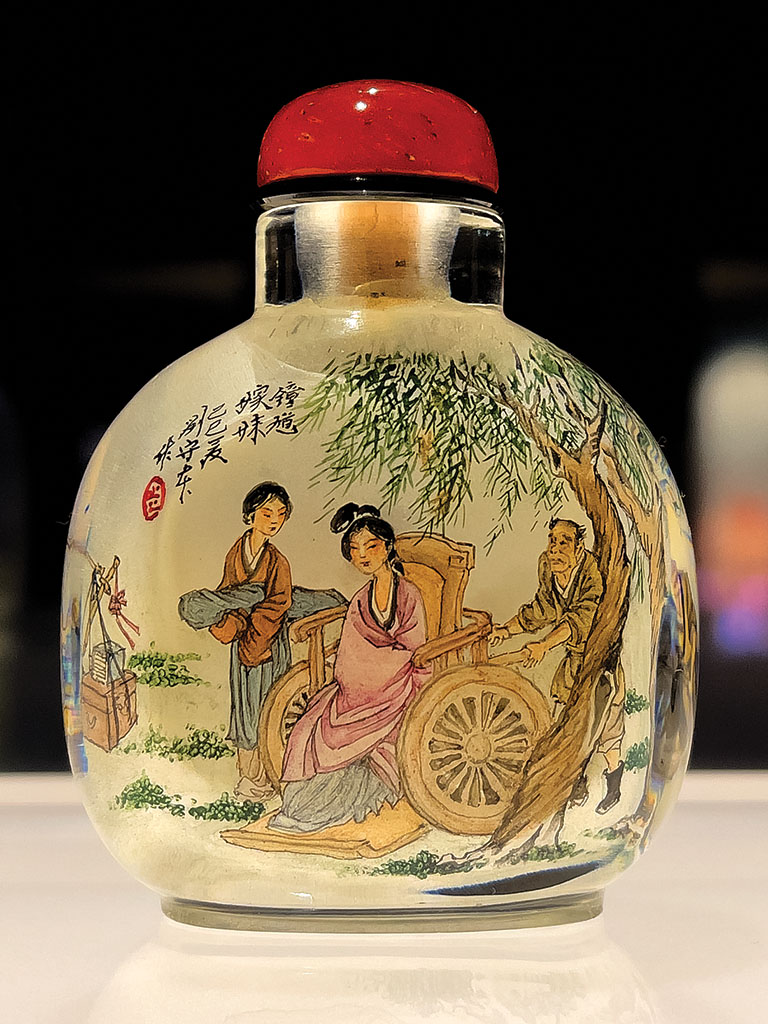
Snuff bottle inside-painted with “the wedding of Zhong Kui’s sister” design Liu Shouben (1942-2022), 1989, Glass
Ma Shaoxuan’s fame led to his being commissioned in 1911 to paint two portraits of the young Xuantong emperor, and he painted portraits of numerous high officials from the late Qing dynasty and the ensuing Republic.
Related Lavishly luxurious life of Qing Emperors and Empresses of Yuan Ming Yuan
A glass snuff bottle, inside-painted with scenes of “Children at play” from 1918, represents Ye Zhongsan’s (1869-1945) speciality in novel-themed bottles.

Snuff bottle inside-painted with Along the River during Qingming Festival, Zheng Shikui (1951- ) and Wang Xisan (1938 – ), Mark of “seven”, 1993, Glass
Ye Zhongsan was skilled at traditional figure painting and was renowned for adapting classical literature into miniature painted narratives.
Related Life memories in Hong Kong Miniatures
He was influenced by his teacher Zhou Leyuan in terms of painting landscapes and bird-and-flower paintings.

Snuff bottle inside-painted with magpie and lotus design, Ma Shaoxuan (1867-1939), 1899 Glass
However, for paintings centring on other themes, Ye Zhongsan drew heavily from the illustrations in The Romance of the Three Kingdoms, Strange Stories from a Chinese Studio, and The Dream of the Red Chamber.
Related Storytelling at the Museum of Hong Kong Literature
Later, he established his own distinctive style and became a crucial link in the transmission of inside painting techniques to the modern era.

Snuff bottle inside-painted with children at play design, 1918, Glass, Ye Zhongsan (1869-1945), Insidepainted
The collection includes a glass snuff bottle inside-painted by Wang Xisan (1938-), founder of the Hebei School.
This bottle, featuring flowers and birds, was created in 1968 during the modern revival period.
Related Sanctuary of rich flora and mesmerising birds
Wang Xisan revolutionised inside painting by inventing flexible metal shaft brushes in 1967, making it possible to paint more detailed and complex scenes inside bottles.

Snuff bottle inside-painted with pines, rocks, flowers and birds, Wang Xisan (1938 – ), 1968, Glass
These brushes were based on Western brush techniques combined with the hooked bamboo pens of the Shandong school, replacing the traditional bamboo pens used before this innovation.
Related Inkgo Lam uses affordable Bamboo to energise beautiful art
This particular bottle holds special significance, as Wang Xisan later added an inscription when he met Christopher Sin in Hong Kong in 1992, creating a testament to the friendship between collector and artist.
Wang Xisan studied at the Beijing Institute of Arts and Crafts in 1957, and his original name was Wang Ruicheng.

Snuff bottle inside-painted with scholars design, Wang Xisan (1938 – ), 1965, Glass
He adopted the name xi “learning” and san “three,” which were the pen names of his teachers Ye Zhongsan and Ye Benqi, establishing a direct lineage from the classical Beijing School masters.
Wang also pioneered the technique of using oil paint as an inside painting medium and founded the modern Ji School in 1977.
Related Daring and irresistibly new Chinese Calligraphy
The Ji School has become the largest and most prominent school of inside painting snuff bottles in China, with Wang Xisan achieving recognition as a true star of inside painting with many of his pupils also gaining international recognition.

Snuff bottle inside-painted with goldfish in pond design, 1908, Glass, Meng Zishou (act. 1904-1919), Insidepainted
In 2023, Mrs Josephine Sin donated the entire Fuyun Xuan Collection to the Hong Kong Museum of Art, ensuring permanent public access to these cultural treasures.
Related Chinese Fragrance: A Feast of Sensational Scents
The collection demonstrates how snuff bottles evolved from practical vessels for holding powdered tobacco into sophisticated works of art that became symbols of status and refinement among the Chinese elite.
Related Chinese motifs and patterns in the art and culture of China
Christopher Sin’s passion for collecting was legendary among international snuff bottle enthusiasts.

Snuff bottle inside-painted with goldfish in pond design, 1891, Rock crystal, Zhou Leyuan (act. 1882-1893), Inside-painted with inscriptions
His collection ensures Hong Kong as a centre for Chinese snuff bottle scholarship and appreciation, while honouring both the collector’s legacy and the artistic traditions these bottles represent.
Related Spirit of Hakka people at Lai Chi Wo Village
The comprehensive nature of the collection, spanning all major materials, techniques, and artistic schools, makes it an invaluable resource for understanding the complete development of this Chinese art form.
Text and photos Martin Wray


